What the Knightscope K7 Is Built to Patrol
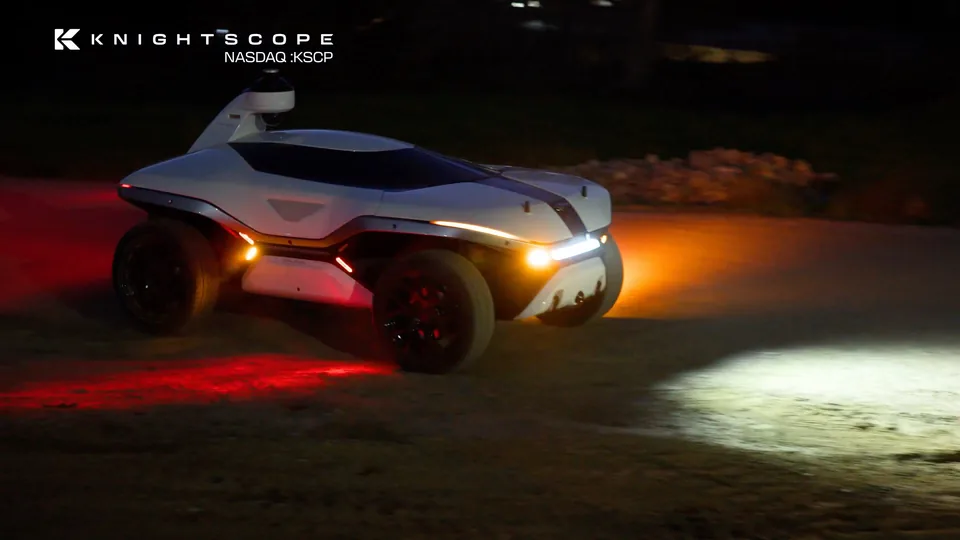
Knightscope designed the K7 for ground the K5 was never meant to cross. Its product page calls it a multi-terrain machine with "light-duty off-road capability" and "long-range navigation," aimed at "large outdoor environments, industrial sites, and logistics hubs."
Knightscope unveiled it on 13 November 2025. The announcement describes a machine meant to "autonomously patrol miles of fence lines, warehouses, open terrain," across properties it calls "too large, too remote, or too dangerous for conventional solutions." The named verticals are critical infrastructure, transportation hubs, logistics yards, industrial complexes and defense installations.
That brief addresses a real gap rather than inventing one. A camera on a pole sees a single fixed cone. A guard in a truck runs a schedule an intruder can learn in a fortnight. The K5 solves neither problem, because it needs mapped, paved, largely flat ground before it can move at all. Nothing in Knightscope’s shipping catalogue drives a gravel fence line today.
Knightscope CEO William Santana Li tied the launch to domestic manufacturing, describing the K7 as "designed and built in America to protect Americans." Our Knightscope company page covers the full catalogue and the company history.
The K7 Specifications Knightscope Publishes
Knightscope publishes five things about the K7. The table below is the complete published set, taken from its K7 product page.
Everything else is missing. There is no weight, no dimensions, no battery capacity, no runtime between charges, no charging time, no drivetrain description and no ground clearance. Knightscope does not say whether the K7 carries lidar or radar alongside the cameras. It publishes no detection range for the thermal sensor.
Of those gaps, runtime does the most damage to a buyer. A machine sold on covering miles of perimeter needs a runtime figure before anyone can work out how much fence one unit watches per charge. Without it, a site cannot tell whether it needs one K7 or four.
The absence reads as a timeline signal rather than evasion. Knightscope published full physical specifications for the K5 years ago. Nine months after the K7 unveiling, the equivalent figures still are not there, which suggests the hardware is not yet frozen.
Ask Knightscope for the runtime, the weight and the ground clearance in writing before treating the K7 as a planned purchase. The Knightscope K7 product page is the only source Knightscope maintains for this list, so check it there for updates.
| Published specification | Knightscope's figure | What it tells a buyer |
|---|---|---|
| Top speed | Up to 10 mph | Roughly three times the K5's pedestrian pace, which makes a mile-long patrol leg practical |
| Video | 360-degree HD video with pan-tilt-zoom (PTZ) and thermal imaging | Thermal is the addition over the K5's visible-light suite. It makes unlit fence lines workable at night without installing site lighting |
| Detection | People, vehicles and licence plates | The same detection set as the K5. The K7 covers more ground with it rather than detecting more things |
| Audio | Live talk-down capability | A remote operator speaks through the machine, so deterrence needs a staffed console |
| Terrain | Light-duty off-road capability, long-range navigation | Gravel, grass and packed dirt rather than rock, mud or steep grades |
| Weight, dimensions, runtime, charging, price | Not published | Cannot be planned around. Request each in writing before committing |
How the K7 Differs from the Knightscope K5
The K5 and the K7 split one site between them. The K5 is a 420-pound, 5-foot-4 wheeled unit that drives a mapped route at about 3 mph across car parks, campus paths and storage aisles. It runs 1 to 1.5 hours between roughly 30-minute charges. Think of it as a moving camera for paved ground people already walk on.
The K7 targets the parts of a property nobody walks.
Speed changes the patrol geometry. At up to 10 mph, a mile of fence becomes a reasonable leg instead of an hour-long crawl. Thermal imaging removes the site-lighting precondition that leaves the K5's visible-light cameras useless along a dark perimeter. Off-road capability lifts the paved-and-mapped requirement that rules the K5 out of most industrial yards.
The response model does not change between them. Neither machine intervenes. Both detect, record, announce and escalate to a person. A K7 patrolling a remote fence line at 3am is worth whatever the response plan attached to it is worth, so settle the staffing question before the hardware question.
For a mixed site these pair rather than compete. A K5 covers the lot and the loading area. A K1 Hemisphere covers the gate. A K7 covers the fence line and the back acreage. Our Knightscope K5 review covers the K5 in full, and the Knightscope alternatives comparison weighs Ascento, SMP Robotics, Asylon Robotics and the rest of the perimeter field.
What Light-Duty Off-Road Covers
Knightscope wrote "light-duty," and the qualifier carries weight. In a wheeled security platform it means graded gravel access roads, mown grass, packed dirt and the compacted surfaces around a logistics yard. It does not mean the terrain a legged robot handles.
Perimeters are rarely uniform. A fence line running 800 yards along a graded service road before crossing a drainage ditch is two problems, and only the first one belongs to a K7. Loose sand, deep mud, standing water, steep embankments and stairs all need either a legged platform or a fixed sensor at the awkward stretch.
Knightscope publishes no gradient limit and no ground clearance figure, so the boundary cannot be read off a specification sheet. Walk the intended route before signing any perimeter-robot contract and mark every surface transition. That survey is standard practice for the K5 for the same reason, and the K7's wider operating envelope makes it more useful rather than less.
Rough or unimproved terrain points somewhere else entirely. Legged platforms handle gradients and obstacles no wheeled chassis will manage. Our industrial quadruped robots page covers that category, and Ghost Robotics is the closest legged comparison for perimeter and defense work.
What the Knightscope K7 Costs
Knightscope publishes no K7 price, and none should be expected before deployment begins. Knightscope does not sell the K5 or the K7 outright. Both mobile robots run on a per-site subscription that bundles hardware, service, connectivity and the operator console into one recurring figure. Its stationary K1 devices work differently and are sold per unit with a service agreement charged separately.
Documented figures elsewhere in the catalogue give the shape of an eventual quote without predicting it. New York City leased a K5 at roughly $9 per hour in its 2023 subway pilot. Knightscope's own 2025 marketing puts the K5 at about $11 per hour against a stated $35 to $85 per hour for contract guards. Stationary devices sit far below that. Knightscope announced the K1 Hemisphere in 2022 at under $1 per hour on an annual agreement.
Where the K7 lands inside that spread is unknown. Anyone quoting a K7 figure today is inventing it.
Budget for the response as well as the robot. The recurring subscription is the visible cost. Console staffing, connectivity across a remote perimeter, and whoever drives out when the machine flags something are the costs that decide whether a deployment works. Our security robot cost guide breaks down what a quoted figure leaves out across the whole category.
Who Should Join the K7 Waitlist
Knightscope opened registrations at its K7 page and says early participants gain priority access to limited series production, with deployment expected to begin in the second half of 2026. That language commits to no shipping date. A roadmap product that has not published its weight nine months after unveiling can move again.
Registering makes sense for a site with a long unlit perimeter, a guard bill that already hurts, and a security budget planned in years rather than quarters. Critical infrastructure, logistics yards and large industrial campuses are the fit Knightscope names. They are also where a fixed camera network gets expensive fastest, because trenching and power runs scale with the fence rather than with the building.
Registering is the wrong answer to a problem you have this quarter. A site needing perimeter coverage now should deploy something that exists: a K5 where the ground is paved and mapped, a tower or trailer unit where it is not. Our mobile surveillance towers and trailers page covers that category in full, and those units go live in days.
In the guides we publish here, readers routinely treat an announced robot as a procurement option. A waitlist entry costs nothing and holds a place in line. A security plan that assumes the K7 arrives on schedule rests on a date Knightscope has never underwritten.
This verdict changes when Knightscope publishes the K7's runtime and weight and names a firm deployment month. Until then, treat the second half of 2026 as an intention rather than a delivery date.
Bottom Line
The Knightscope K7 has a credible brief and a thin specification sheet. Its 10 mph top speed, thermal imaging and off-road capability address the gap the K5 leaves open. That gap is the unlit unpaved perimeter, which fixed cameras cover badly and guards cover expensively. Knightscope publishes none of the figures needed to size a deployment, and on its own schedule the machine will not arrive before the second half of 2026. Register for the waitlist if a long remote perimeter is a standing problem. Solve this year's coverage with a K5, a fixed tower or a trailer unit that exists today.
See the full Knightscope catalogue on the Knightscope company page, compare the shipping mobile unit in our Knightscope K5 review, weigh rival vendors in Knightscope alternatives, and check what the category costs in our security robot cost guide.
FAQs
How fast is the Knightscope K7?
Knightscope publishes a top speed of up to 10 mph for the K7. That is roughly three times the K5's pace of about 3 mph. That extra speed turns a mile of fence into one patrol leg instead of an hour-long crawl.
Is the Knightscope K7 available to buy?
No. Knightscope lists the K7 under development rather than as a shipping product, with limited series production expected to begin deployment in the second half of 2026. Registrations are open at the Knightscope K7 page for priority access. Knightscope also does not sell its mobile robots outright, so the K7 will be a per-site subscription when it does deploy.
How much does the Knightscope K7 cost?
Knightscope publishes no K7 price and quotes its mobile robots per site. For scale, New York City leased a K5 at about $9 per hour in 2023. Knightscope's own 2025 comparison puts the K5 at roughly $11 per hour against $35 to $85 per hour for contract guards. No published figure exists for the K7, and any specific number quoted today is invented.
What is the difference between the Knightscope K5 and K7?
The K5 is the shipping outdoor patrol robot for structured, paved, mapped environments such as car parks and campuses, moving at about 3 mph with visible-light cameras. The K7 is a multi-terrain machine for fence lines, logistics yards and industrial perimeters, with light off-road capability, speeds up to 10 mph, and thermal imaging alongside the HD video. The K5 ships today. The K7 remains a roadmap product.
Does the Knightscope K7 have thermal cameras?
Yes. Knightscope publishes 360-degree HD video with pan-tilt-zoom and thermal imaging for the K7. Thermal is the addition over the K5's visible-light suite. It makes an unlit perimeter workable at night without installing site lighting along the fence.
What terrain can the Knightscope K7 handle?
Knightscope describes light-duty off-road capability. In a wheeled security platform that means graded gravel roads, mown grass, packed dirt and the compacted surfaces around a logistics yard. Knightscope publishes no gradient limit and no ground clearance figure, so treat mud, loose sand, steep embankments and stairs as out of scope until Knightscope states otherwise in writing. Sites with genuinely rough ground should compare legged platforms instead.
Can the Knightscope K7 stop an intruder?
No. The K7 detects, records, announces and escalates, and live talk-down lets a remote operator speak through the machine. It does not intervene physically, and neither does any other Knightscope product. Deterrence value depends entirely on someone being staffed to answer the alert and respond, which is a cost to budget alongside the subscription.