What the Knightscope K5 Is and What It Does on Patrol
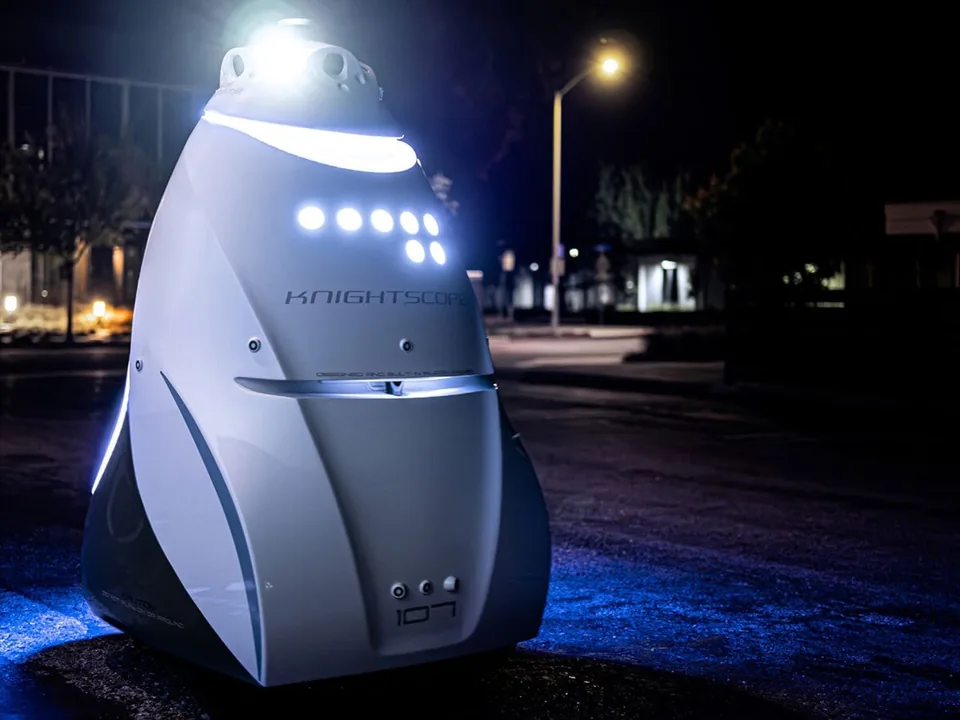
The Knightscope K5 is an autonomous outdoor security robot that drives a pre-mapped patrol route, records everything it passes, and raises alerts to a remote console. Knightscope calls it an Autonomous Security Robot, or ASR, and positions it for what the company describes as "structured outdoor environments where visibility, deterrence, and consistent coverage matter most."
On shift, the machine leaves its dock and follows a route the vendor programmed against a map of the property. It rolls at pedestrian speed across parking lots, campus paths, and storage aisles. Cameras run continuously. When something crosses its path, it stops, plays a spoken message, and steers around the obstruction before resuming the route.
The deterrence tools are limited and worth naming precisely. Knightscope's product page lists quad strobe lights, two-way audio, and broadcast messaging. No weapon appears anywhere in the published capability list. A K5 can film a person, talk to a person, and flash at a person. It cannot detain, restrain, open a door, or climb a step.
That gap is the whole buying decision. The K5 replaces the walking part of a patrol and the paperwork part of an incident log. It does not replace the moment a human has to decide something. Knightscope now sells the robot inside a bundle it calls the Force, which pairs the machines with remote analysts and licensed field agents. The full company and product line is covered on our Knightscope company page; this review is about the K5 machine itself.
Knightscope K5 Specs: Size, Weight, and Speed
The Knightscope K5 stands 5 feet 4 inches tall, weighs 420 pounds, and travels at roughly 3 mph at its top speed. Those three figures are the ones to plan around, because they determine where the machine physically fits and how much ground it can actually cover in a shift.
At 3 mph the K5 moves slightly slower than an average adult walking pace. A single unit covering a 20-acre lot will take a long time to complete one loop, and it will only ever be at one point on that loop. Buyers who size a deployment on area rather than on route time end up with coverage gaps they did not price in.
The 420-pound mass matters for a different reason. It is heavy enough to injure someone in a collision and heavy enough that staff cannot simply lift it out of the way when it gets stuck. Any surface the K5 patrols has to be paved, load-bearing, and free of steps.
Knightscope does not publish a full dimensional spec sheet for the K5 on its current product pages. Width, turning radius, ground clearance, ingress protection rating, and operating temperature range are not stated publicly. Third-party listings quote numbers for several of these, and they disagree with each other. Ask for the written spec sheet during evaluation rather than trusting a repost.
| Spec | Figure | Provenance |
|---|---|---|
| Height | 5 ft 4 in | Verified |
| Weight | 420 lb | Verified |
| Top speed | About 3 mph | Verified |
| Patrol time per charge | 1 to 1.5 hours, depending on the location | Knightscope, company-published |
| Recharge time | About 30 minutes | Knightscope, company-published |
| Environment | Outdoor, paved, structured | Knightscope, company-published |
| Width, turning radius, IP rating, temperature range | Not published by Knightscope | Absent from vendor materials |
The Sensor Suite: What Knightscope Publishes and What It Does Not
Knightscope publishes the K5's sensing outcomes but not a component-level sensor list. The company states the machine provides 360-degree high-definition video with thermal imaging, detection of people, devices, and license plates, two-way audio with broadcast messaging, quad strobe lights, and real-time alerts with continuous recording.
The fifth-generation K5, which began shipping in December 2023, raised the camera elevation to near eye level for 4K video capture, added lighting for nighttime visibility, and improved the broadcast, intercom, and public-address audio. Knightscope also cites a new battery architecture and a wider stance for the propulsion system in that revision.
Counts of lidar and sonar units circulate widely on aggregator pages. Knightscope's own fifth-generation announcement does not state them, and neither does the current K5 product page. This review will not assert a number the vendor has not published. If lidar redundancy matters to your risk assessment, put it in writing during procurement.
The device detection deserves a plain description, because it is the capability most buyers misread. The K5 logs wireless device identifiers and license plates it passes, which produces a searchable record of which phones and vehicles were present. Facial recognition is not listed among the K5's published capabilities. The privacy conversation with a works council, a tenant board, or a city attorney should happen before the contract, not after the first alert.
- Published: 360-degree HD video with thermal imaging
- Published: detection of people, devices, and license plates
- Published: two-way audio, intercom, and broadcast messaging
- Published: quad strobe lights for deterrence
- Published: continuous recording and real-time alerting
- Not published: lidar count, sonar count, camera count, sensor model numbers
- Not listed: facial recognition on the K5
How Autonomy, Navigation, and Charging Work
The K5 navigates a pre-mapped property autonomously and returns to its dock on its own when the battery runs down. Setup begins with a map of the site, after which Knightscope programs the patrol routes; the company says operators can adjust routes without waiting on support.
Knightscope publishes the duty cycle plainly, which is unusual for this category. The K5 patrols for 1 to 1.5 hours per charge depending on the location and recharges in about 30 minutes. It returns to the charging station without human intervention and can run from one docking station to another across a larger site.
Work that duty cycle through and a real planning constraint appears. On the published figures, a K5 spends somewhere near a quarter to a third of every hour of the day parked on a dock. Continuous coverage of a site therefore depends on dock placement and dock count, not on the robot alone. Two docks at opposite ends of a lot keep the machine productive; one dock at the far corner of a large property spends patrol time on the commute.
Everything is monitored through a browser-based console rather than a dedicated guard station, and Knightscope layers its own remote analyst team on top for clients who buy it. The K5 does not require an operator to drive it. It does require someone to read what it sends, which is the same staffing question that applies across security robots generally.
Knightscope K5 Price and Contract Terms
Knightscope currently publishes an effective cost of about $11 per hour for the K5, against a stated $35 to $85 per hour for human security guards. That $11 figure is the company's own current number and supersedes the roughly $8 to $9 per hour Machine-as-a-Service rate this site published previously. The older figure reflected earlier Knightscope materials; the rate has moved, and this page uses the current one.
The commercial model is a subscription Knightscope calls Machine-as-a-Service. The monthly fee covers setup, ongoing maintenance, software updates, and hardware replacement. Knightscope describes the K5 as running on an annual subscription, in its own words "just like your cable, mobile phone or internet service." Clients on that model have been moved to fifth-generation hardware through swap-outs rather than paying for a new machine.
There is no published list price to buy a K5 outright, because Knightscope does not sell it that way. Anyone quoting you a purchase price for a K5 is quoting something Knightscope has not published.
Two questions decide what the hourly rate actually means for your site. First, is the rate billed against calendar hours or patrol hours, given that the machine docks to charge for part of every cycle. Second, what is included at renewal if the hardware generation changes. Get both in the contract. Broader category benchmarks are in our security robot cost breakdown.
| Item | Figure | Provenance |
|---|---|---|
| K5 effective hourly cost | About $11 per hour | Knightscope, company-published |
| Human guard comparison | $35 to $85 per hour | Knightscope, company-published |
| Model | Machine-as-a-Service, monthly fee | Knightscope, company-published |
| What the fee covers | Setup, maintenance, software updates, hardware replacement | Knightscope, company-published |
| Term | Annual subscription | Knightscope, company-published |
| Outright purchase price | Not published; not sold as a capital purchase | Absent from vendor materials |
| Previously published on this site | About $8 to $9 per hour | Superseded by the current vendor figure |
Where the K5 Is Actually Deployed
K5 units patrol commercial real estate, casinos, hospitals, self-storage yards, logistics sites, residential communities, and transportation facilities across the United States. Knightscope publishes contract activity regularly, and the pattern in those announcements is more useful than any single marquee name.
Renewals are the signal worth reading. In January 2025 Knightscope announced seven client renewals, including a casino in Iowa entering its third year and a hospital in Texas entering its seventh. A further batch announced in April 2025 included a sixth-year casino renewal alongside self-storage, hospitality, healthcare, residential, and logistics clients. A machine that gets renewed for seven consecutive years at a hospital is doing something the buyer values.
Self-storage has been one of the strongest fits. The sites are paved, fenced, repetitive, mostly unstaffed overnight, and full of vehicles with plates worth logging. The K5's weaknesses barely apply there, and its license-plate logging maps directly onto the operator's own incident workflow.
Law enforcement use has been narrower and more contested. In January 2025 an Ohio police department became the first customer for the upgraded K5, and Huntington Park Police in California renewed for a sixth year in 2024. Public-agency deployments of ground robots are covered separately in our reporting on robots on border patrol.
Documented Knightscope K5 Incidents and Real Limits
The K5 has a public incident record that a buyer should read before signing, and none of it is secret. Four episodes account for most of the coverage, and each one points at a specific limitation rather than at a general verdict.
In July 2016 a K5 at Stanford Shopping Center in Palo Alto collided with a 16-month-old child and rolled over his foot. Knightscope's own account said the machine did not register the obstacle correctly. Injuries were minor. The lesson holds: obstacle handling is tuned for adults moving predictably, not for small children moving backwards.
In July 2017 a K5 at the Georgetown waterfront in Washington DC drove into a fountain and stopped working. In October 2019 a bystander at Salt Lake Park in Huntington Park, California pressed a K5's emergency button during a fight and was told to step out of the way. The button was not connected to police dispatch, and officers had no access to the robot's video stream. That failure was integration, not robotics, and it is the single most repeatable mistake a buyer can make with this machine.
From September 2023 a K5 patrolled the Times Square subway station in New York overnight under a contract with the city. Two NYPD officers escorted it at all times, and the NYPD ended the pilot after roughly two months of active patrol, inside a longer contract term, and the robot was later parked in a vacant storefront. Underground transit stations have stairs, escalators, crowds, and no GPS, which is close to the opposite of what the K5 was built for.
| Incident | When | What happened | What a buyer should take from it |
|---|---|---|---|
| Stanford Shopping Center, Palo Alto | July 2016 | K5 collided with a 16-month-old and rolled over his foot; Knightscope said sensors did not register the obstacle correctly | Obstacle handling assumes adult-sized, predictable movement |
| Georgetown waterfront, Washington DC | July 2017 | K5 drove into a fountain and stopped working | Surface transitions and water features must be excluded from the map |
| Salt Lake Park, Huntington Park, CA | October 2019 | Bystander pressed the emergency button during a fight; the button was not routed to police dispatch | Escalation routing is a contract item, never a default |
| Times Square subway station, New York | Sept 2023; ~2 months of active patrol | K5 patrolled overnight escorted by two officers; pilot ended after about six months | Stairs, crowds and no GPS are outside the K5's envelope |
How the K5 Compares in the Line, and Who It Suits
The K5 is Knightscope's outdoor mobile unit, and the rest of the line covers the jobs it cannot do. The K1 Hemisphere is a stationary entry-point device with up to roughly 210 degrees of eye-level video, two-way audio with a call button, automated announcements, a strobe, and detection of people, vehicles, and license plates. The K1 Blue Light Tower is an elevated deterrent with high-output lighting and mass notification. Knightscope lists a larger outdoor K7, a K1 Super Tower in 7, 14, and 21 foot configurations, and a compact K1 Capsule as under development rather than shipping.
Pairing beats substituting. A K5 covering the lot and a K1 Hemisphere covering the gate solve different halves of the same site, and the gate device never has to leave to charge. Sites that need indoor coverage need a different machine entirely; Cobalt AI builds for corridors and lobbies rather than parking structures.
The K5 suits paved, fenced, repetitive outdoor sites that run overnight with thin staffing: self-storage, surface lots, distribution yards, campus perimeters, and residential communities. It suits buyers who want an incident record and a visible deterrent, and who already have someone who will act on an alert.
It does not suit sites with stairs, gravel, snow, tight indoor corridors, or unmapped terrain. It does not suit buyers who expect it to intervene. And it does not suit anyone who has not decided in advance where an alert goes at 3am. Legged platforms from Ghost Robotics handle rough ground the K5 cannot, at a very different price. Other wheeled and indoor options are compared in our Knightscope alternatives rundown.
Bottom Line
The Knightscope K5 is a competent, narrow machine sold on a clear commercial model. The verified physical numbers are 5 feet 4 inches, 420 pounds, and about 3 mph, with 1 to 1.5 hours of patrol between roughly 30-minute charges, and Knightscope's current published rate is about $11 per hour on a Machine-as-a-Service subscription. Its published capability list is genuinely useful and genuinely limited: video, thermal, plate and device logging, voice, and lights. The incident record shows a machine that fails at the seams, where a robot meets a child, a fountain, a staircase, or a dispatch system nobody wired up. Buy it for paved, repetitive outdoor ground where you already know who answers the alert.
Compare hourly and annual figures across the category in our security robot cost guide, see the full product line and company history on the Knightscope company page, and weigh other wheeled and indoor patrol options in Knightscope alternatives.
FAQs
How much is a Knightscope K5?
Knightscope publishes an effective cost of about $11 per hour for the K5, compared with a stated $35 to $85 per hour for human security guards. That is a subscription rate under the company's Machine-as-a-Service model, and the monthly fee covers setup, maintenance, software updates, and hardware replacement. The figure has risen from the roughly $8 to $9 per hour previously published, so quote your own site rather than relying on an older number.
Can you buy a Knightscope K5 outright?
No. Knightscope does not publish a purchase price for the K5 and sells it only as an annual subscription. The company compares the arrangement to a cable or mobile phone service. One practical benefit of that structure is that clients on subscription have been moved onto fifth-generation hardware through swap-outs rather than buying a replacement machine.
What does ASR mean on the Knightscope K5?
ASR stands for Autonomous Security Robot, which is Knightscope's product category name for its self-driving patrol machines. The K5 is the outdoor ground ASR. The K1 Hemisphere and the blue light towers are stationary devices in the same family rather than ASRs.
How fast is the Knightscope K5 and how long does it run?
The K5 tops out at roughly 3 mph, slightly under a normal adult walking pace. Knightscope states it patrols for 1 to 1.5 hours per charge depending on the location and recharges in about 30 minutes, returning to its dock without human intervention. Plan dock placement around that cycle, because the machine is off-route for a meaningful share of every hour.
Does the Knightscope K5 have facial recognition?
Facial recognition is not listed among the K5's published capabilities. Knightscope's product page describes detection of people, devices, and license plates, which means the machine logs wireless device identifiers and vehicle plates it passes. That is still a surveillance capability worth clearing with tenants, staff, or counsel before deployment.
Is the Knightscope K5 armed?
No weapon appears in Knightscope's published capability list for the K5. Its deterrence tools are quad strobe lights, broadcast audio, and two-way intercom. The machine is designed to be seen, heard, and recorded from, and to escalate to a human rather than to act.
Can the Knightscope K5 work indoors?
The K5 is built for structured outdoor environments and needs paved, step-free, mapped ground. It cannot use stairs or escalators, which ended its New York subway pilot in 2024 after officers had to escort it throughout. Indoor patrol is a different product category, served by machines designed for corridors, lobbies, and elevators.
What is the biggest mistake buyers make with a Knightscope K5?
Not deciding in advance where an alert goes and who acts on it. In the most widely reported K5 failure, a bystander in Huntington Park pressed the robot's emergency button during a fight and the button was not connected to police dispatch. The robot worked as designed; the escalation path did not exist. Specify routing, response times, and video access in the contract.
Primary Sources
- Knightscope: K5 product page
- Knightscope: How the K5 Robot Patrols Without Human Help
- Knightscope: How Autonomous Robots are Revolutionizing Public Safety (pricing)
- Knightscope: The Force (product line and Signals platform)
- Knightscope: K1 Hemisphere
- Knightscope: The Fifth Generation K5
- Businesswire: Knightscope Begins Shipping 5th Generation K5 ASR
- Businesswire: Knightscope K5 Upgrade Expands Market Reach
- Businesswire: Huntington Park Police Renews Knightscope Contract for 6th Year
- Palo Alto Online: Stanford Shopping Center security robot knocks down toddler
- NBC News: RoboCop, a park fight, and clashing expectations (Huntington Park)
- NBC New York: NYPD subway robot pilot program ends
- Security Info Watch: Knightscope announces seven contract renewals and 5th-gen upgrades