Run the Passage-Width Test
Small lawns look like the easy case and frequently are not. Area ratings are generous, so almost any model qualifies on paper, and the real constraints are geometric. Compact wire-bounded models such as Gardena Sileno and smaller Worx Landroid units are often a better small-garden fit than a large wire-free machine, while Segway Navimow and Mammotion need enough open sky for their RTK signal, which tight urban gardens do not always give.
The Bot Scout passage-width test measures the three tightest points in the garden: the gap between a bed and a fence, the path between front and back, and the space beside the shed. If the mower cannot reliably traverse those, it will mow one region well and leave the rest, which reads as a fault but is a specification mismatch.
Obstacle density is the second factor. A small lawn interrupted by beds, trees, a trampoline, and furniture has far more edge relative to area than a large open lawn, and edges are where robot mowers are weakest.
| Small-yard feature | Why it matters | What to check | Sign of a mismatch |
|---|---|---|---|
| Narrow side passage | Connects lawn regions | Minimum supported width | One region never cut |
| High obstacle count | More edge per square metre | Obstacle handling method | Frequent stoppages |
| Short run time needed | Small area cuts quickly | Whether scheduling is flexible | Runs longer than the lawn needs |
| Base placement | Limited space and power access | Base footprint and clearance | No sensible spot for the dock |
| Unfenced front garden | Theft and public access | Security features | Unit visible from the street |
Boundary Choice in a Small Space
Wire boundaries are reliable and become fiddly in gardens with many beds, because every island needs its own loop. Vision and satellite systems avoid that work but can struggle with overhang, fences, and tight sight lines typical of small urban gardens.
Whichever type, what matters more is recovery behaviour when the boundary or signal is lost, which is the boundary-recovery discipline in the robot lawn mower guide.
For gradient-specific questions, see the slopes guide, and for the general shortlist see the best robot mower guide.
- Measure the three narrowest passages before shortlisting.
- Count islands and obstacles rather than estimating area.
- Choose a boundary type that suits many small beds.
- Plan base location, power route, and winter storage.
- Consider theft exposure in an unfenced front garden.
When a Robot Mower Is Overkill
For a very small, simple lawn a push mower takes a few minutes and costs a fraction as much. The robot earns its place when cutting is frequent, awkward, or physically difficult, not merely when the lawn is small.
Robot mowers also work by cutting little and often, so a lawn left for weeks needs a conventional cut before the robot can take over. That rhythm suits some households and irritates others.
The honest recommendation is to buy for the geometry and the routine rather than the area figure on the box.
Where To Buy
The models below are the ones we point readers at, listed in the order we would consider them. We earn a commission if you buy through these links, at no extra cost to you — it never changes which robots make the list.
Segway Navimow i110N
Best small-yard mowerWire-free mowing for yards up to about a quarter acre. Satellite positioning replaces the buried perimeter wire, which removes the single most painful part of owning a robot mower.
Check price on AmazonAffiliate link. Price and stock change constantly, so we show them only on Amazon.
- No perimeter wire. Satellite positioning
- Rated to roughly 1/4 acre
- App-defined mowing zones
- No wire to bury or repair
- Simple setup for a small, open lawn
- Needs clear sky view to hold position
- Not for heavily treed yards
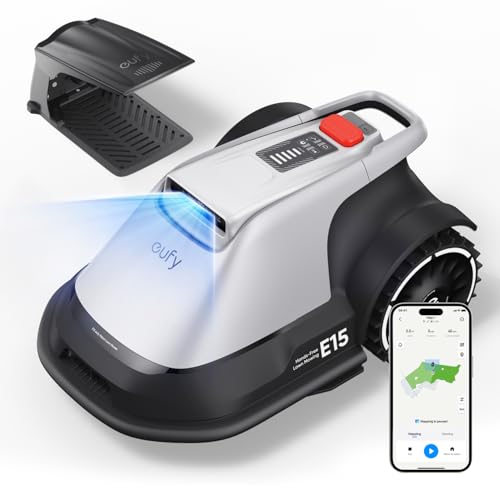
eufy E15
Best camera-navigation mowerNavigates by camera rather than satellite, so tree cover and narrow side yards do not break positioning the way they can on a satellite-only mower.
Check price on AmazonAffiliate link. Price and stock change constantly, so we show them only on Amazon.
- Vision-based navigation
- No perimeter wire
- Auto mapping
- Works under tree cover where satellite mowers struggle
- Wire-free setup
- Newer platform with a shorter track record
- Camera navigation slows in low light
Bottom Line
For small yards, passage width and obstacle density decide the purchase. Measure the tightest gaps, choose a boundary type that suits many beds, and ignore the area rating.
Measure your three narrowest passages before shortlisting on lawn area.
FAQs
Does lawn area matter for a small yard?
Barely. Almost every model covers a small area on paper. Passage width between regions and obstacle density decide whether the mower works.
Can a robot mower handle a garden with many flower beds?
It depends on the boundary type. Wire loops become fiddly with many islands, while vision and satellite systems avoid that but can struggle with overhang and tight sight lines.
Is a robot mower worth it for a small lawn?
It earns its place when cutting is frequent, awkward, or physically difficult. For a very small simple lawn, a push mower is quicker and far cheaper.
What about theft in a front garden?
Unfenced front gardens expose the unit to the street. Check the security features and consider base placement out of direct view.
Primary Sources
Still deciding? Our top pick above, the Segway Navimow i110N, is the one we'd point you at.