Run the Wet-Slope Test
Gradient is the specification most often skimmed and most often decisive, and it is where all-wheel-drive models separate from the rest. Husqvarna Automower AWD models and the Mammotion Luba AWD range publish the highest slope ratings, while most two-wheel-drive Segway Navimow and Worx Landroid models are built for gentler ground. Read each model's published maximum rather than the brand's headline.
The Bot Scout wet-slope test replaces the average with the worst case: measure the steepest section of the lawn, not the overall fall, and evaluate against it in the condition that actually causes failures, which is wet grass. A published maximum is a dry-conditions figure, and traction on damp turf is materially worse.
The failure mode is not usually dramatic. It is a mower that slips, leaves uncut stripes, tracks mud across the lawn, and gradually stops completing its schedule.
| Slope factor | Why it matters | How to check | Mismatch signal |
|---|---|---|---|
| Steepest section | Decides the rating needed | Measure gradient, not average fall | Uncut stripes on the bank |
| Wet-grass traction | Where slipping happens | Wheel type and drive method | Mud tracks after rain |
| Slope near a boundary | Risk of overrun | Behaviour at the edge on a hill | Mower reaching a fence or drop |
| Base on a gradient | Docking reliability | Level area for the base | Repeated failed docking |
| Terracing or steps | Not a slope problem at all | Whether regions connect | Separate lawns needing separate units |
Safety and Boundaries on a Hill
Slopes concentrate risk at the edges. A boundary at the bottom of a bank, next to a road, a wall, or a drop deserves a wider margin than the manufacturer's minimum, because a slipping mower travels further than a level one.
Boundary technology behaves differently on a hill too: wire depth and signal can be affected by terrain, and vision or satellite systems can lose reference against a sky-limited view. Recovery behaviour matters more than setup convenience, which is the point made in the robot lawn mower guide.
For narrow passages and dense obstacles rather than gradient, see the small yards guide.
- Measure the steepest section and compare it to the published maximum.
- Assume worse traction in wet conditions than the rating implies.
- Give boundaries on a bank a wider margin than the minimum.
- Site the base on a level area for reliable docking.
- Check whether terraced regions need separate coverage.
When to Split the Lawn
A garden with a steep bank and a level lawn is often better served by robot-mowing the flat area and handling the bank manually or with a dedicated tool, rather than buying a higher-rated machine for one difficult section.
Terraced gardens where regions do not connect are effectively separate lawns. If the mower cannot travel between them, it needs either a second unit or a manual routine, and that should be decided before purchase rather than after.
The honest position is that slopes reduce the addressable area rather than ruling out a robot, and matching the machine to the flat majority is usually the better value.
Where To Buy
The models below are the ones we point readers at, listed in the order we would consider them. We earn a commission if you buy through these links, at no extra cost to you — it never changes which robots make the list.
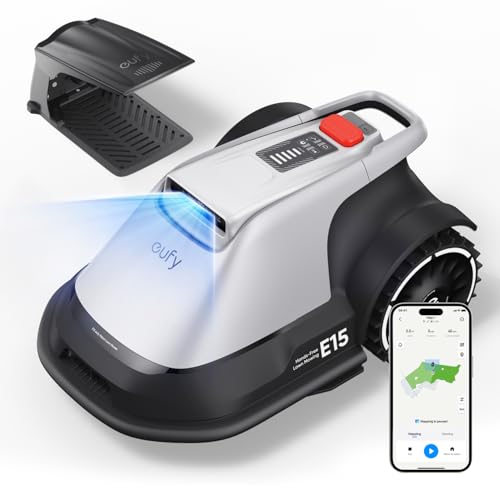
eufy E15
Best camera-navigation mowerNavigates by camera rather than satellite, so tree cover and narrow side yards do not break positioning the way they can on a satellite-only mower.
Check price on AmazonAffiliate link. Price and stock change constantly, so we show them only on Amazon.
- Vision-based navigation
- No perimeter wire
- Auto mapping
- Works under tree cover where satellite mowers struggle
- Wire-free setup
- Newer platform with a shorter track record
- Camera navigation slows in low light
Segway Navimow i110N
Best small-yard mowerWire-free mowing for yards up to about a quarter acre. Satellite positioning replaces the buried perimeter wire, which removes the single most painful part of owning a robot mower.
Check price on AmazonAffiliate link. Price and stock change constantly, so we show them only on Amazon.
- No perimeter wire. Satellite positioning
- Rated to roughly 1/4 acre
- App-defined mowing zones
- No wire to bury or repair
- Simple setup for a small, open lawn
- Needs clear sky view to hold position
- Not for heavily treed yards
Bottom Line
Specify a sloped lawn against the steepest wet section, not the average. Widen boundary margins on banks, and consider mowing the flat area robotically and the bank manually.
Measure the steepest section of your lawn and compare it to each model's published maximum.
FAQs
What slope can a robot mower handle?
Each model publishes a maximum gradient. Treat it as a dry-conditions figure and specify against the steepest section of your lawn rather than the average fall.
Do robot mowers slip on wet grass?
Traction is materially worse on damp turf, which is where most slope failures occur. Expect performance below the published maximum after rain.
Are boundaries riskier on a slope?
Yes. A slipping mower travels further than a level one, so boundaries near roads, walls, or drops deserve a wider margin than the minimum.
Should I buy a higher-rated mower for one steep bank?
Often not. Mowing the flat majority robotically and handling the bank manually is usually better value than paying for a rating you need in one place.
Primary Sources
Still deciding? Our top pick above, the eufy E15, is the one we'd point you at.