The Best Robot Mowers by Yard Type
There is no single best robot mower, because the brands are built around different yard shapes. Husqvarna Automower covers the widest range and includes high-slope AWD models; Segway Navimow and Mammotion Luba lead the wire-free open-lawn category; Worx Landroid is the value option; and Gardena Sileno suits small wire-bounded gardens.
The number every brand markets is a maximum lawn area, and it predicts far less than it appears to. Match the model to yard shape instead: the tightest passage between sections, the number of islands and obstacles, the steepest slope, and the boundary method. A 400 square metre rectangle and the same area split across three sections joined by a metre-wide path are different purchases.
The narrow passage is the usual failure. A mower that cannot reliably find and traverse a connecting path mows one section and leaves the others, which reads as a navigation fault but is a specification mismatch.
| Yard type | Strong fit | Why | Verify |
|---|---|---|---|
| Open lawn, clear sky | Segway Navimow, Mammotion | Wire-free RTK works best in the open | Signal against tree cover |
| Large or sloped lawn | Husqvarna Automower AWD, Mammotion Luba AWD | Traction and published slope ratings | Gradient vs steepest wet section |
| Budget or mid-size | Worx Landroid | Lower price, wire or Vision options | Which boundary the model uses |
| Small wire-bounded garden | Gardena Sileno, STIHL iMOW | Simple, reliable, dealer support | Passage width and dock spot |
| Complex multi-zone garden | Vision or RTK with zones | Flexible boundaries and no-go areas | How islands are excluded |
Boundary Type Is the Long-Term Decision
Boundary technology determines the setup effort and how easily the lawn can change later. A buried wire is reliable and inflexible; satellite and vision-based systems are quicker to reconfigure and more sensitive to obstruction and site conditions.
Whichever type, the recovery behaviour matters more than the setup: what the mower does when it loses the boundary or signal is the boundary-recovery discipline covered in the robot lawn mower guide.
Theft and security also belong in the comparison for unfenced front gardens, along with the practical question of where the charging base sits and how power reaches it.
- Measure the narrowest passage between lawn sections.
- Count islands and obstacles rather than estimating area alone.
- Check the maximum slope figure against your steepest section.
- Choose the boundary type for how the yard will change, not just today.
- Plan the base location, power route, and winter storage.
Husqvarna Automower vs Segway Navimow: The Two Leading Systems
Husqvarna Automower and Segway Navimow are the two names buyers compare most often once they narrow past the yard-type filter above, because they represent the two dominant boundary approaches: proven wire and EPOS satellite versus wire-free RTK.
Husqvarna's range spans buried-wire models through its wire-free EPOS satellite line, and its AWD models carry the highest published slope ratings in this guide, which is why steep or large lawns favor Husqvarna first. Segway Navimow is wire-free RTK only, which means faster setup with no trench to dig, but performance depends on a clear view of sky for satellite signal, so tree cover is the deciding factor rather than lawn size.
Neither brand publishes a single price that covers every lawn size and slope; both scale by model, area coverage, and AWD or non-AWD configuration.
| Factor | Husqvarna Automower | Segway Navimow |
|---|---|---|
| Boundary method | Buried wire or wire-free EPOS satellite | Wire-free RTK only |
| Best yard type | Large or sloped lawns, AWD models for gradient | Open lawn with a clear view of sky |
| Setup effort | Wire models need trenching; EPOS models do not | No trenching, but needs RTK signal calibration |
| Slope handling | Highest published slope ratings among wire-free options in this guide | Two-wheel-drive models built for gentler ground |
| Main risk to verify | Wire fault-finding if using buried boundary | Signal loss under heavy tree cover |
Maintenance and Seasonal Reality
Blades wear and need replacing on a schedule, the underside needs clearing of clippings, and most owners store the unit and its base over winter. None of that is difficult, and all of it is work that did not exist before.
Cutting frequency is the trade that surprises new owners. Robot mowers work by cutting little and often rather than removing a large amount at once, so a lawn left uncut for weeks needs a conventional mow before the robot takes over again.
For the broader category framing and the alternative of a conventional mower, use the robot lawn mower guide and the ownership tests in the consumer robots hub.
Where To Buy
The models below are the ones we point readers at, listed in the order we would consider them. We earn a commission if you buy through these links, at no extra cost to you — it never changes which robots make the list.
Segway Navimow i110N
Best small-yard mowerWire-free mowing for yards up to about a quarter acre. Satellite positioning replaces the buried perimeter wire, which removes the single most painful part of owning a robot mower.
Check price on AmazonAffiliate link. Price and stock change constantly, so we show them only on Amazon.
- No perimeter wire. Satellite positioning
- Rated to roughly 1/4 acre
- App-defined mowing zones
- No wire to bury or repair
- Simple setup for a small, open lawn
- Needs clear sky view to hold position
- Not for heavily treed yards
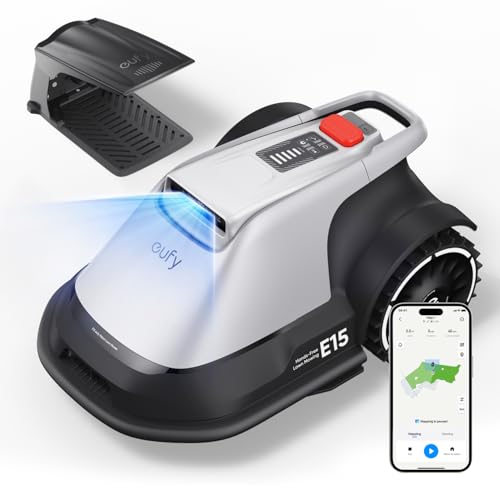
eufy E15
Best camera-navigation mowerNavigates by camera rather than satellite, so tree cover and narrow side yards do not break positioning the way they can on a satellite-only mower.
Check price on AmazonAffiliate link. Price and stock change constantly, so we show them only on Amazon.
- Vision-based navigation
- No perimeter wire
- Auto mapping
- Works under tree cover where satellite mowers struggle
- Wire-free setup
- Newer platform with a shorter track record
- Camera navigation slows in low light
Bottom Line
The best robot mower is the one that matches your yard's passages, islands, slopes, and boundary needs. Treat the advertised lawn area as a starting filter rather than the decision.
Measure your narrowest passage and steepest slope before shortlisting on lawn area. If Husqvarna's price or dealer network is the sticking point, see Husqvarna Automower alternatives.
FAQs
How do I choose a robot mower for my lawn?
Start with yard shape rather than area. Measure the narrowest passage between sections, count islands and obstacles, check the steepest slope, and decide which boundary type suits the yard.
Can a robot mower handle multiple lawn areas?
Only if it supports the passage width connecting them. A mower that cannot reliably traverse a narrow connecting path will mow one section and leave the others uncut.
Are wire or wireless robot mower boundaries better?
A buried wire is reliable but inflexible. Satellite and vision-based boundaries are easier to reconfigure but more sensitive to obstruction and site conditions. Choose for how the yard will change.
How much maintenance does a robot mower need?
Blade replacement on a schedule, clearing clippings from the underside, and winter storage for the unit and base. Robot mowers also need to cut frequently rather than reclaiming an overgrown lawn.
Husqvarna Automower or Segway Navimow: which should I choose?
Choose Husqvarna Automower for large or sloped lawns, since its AWD models carry the highest published slope ratings between the two, and its EPOS satellite option skips trenching if you don't want a buried wire. Choose Segway Navimow for an open lawn with a clear view of sky, where its wire-free RTK system sets up fastest with no wire to bury at all.
Segway Navimow or Mammotion: which handles a tree-covered yard better?
Mammotion handles heavy tree cover better. Its YUKA line and the base LUBA 3 AWD configuration run on LiDAR and AI vision, with no RTK satellite signal required. Every Segway Navimow model still depends on a working Network RTK fix instead. See our full Segway Navimow vs Mammotion comparison for price and coverage-area detail on both lineups.
Primary Sources
Still deciding? Our top pick above, the Segway Navimow i110N, is the one we'd point you at.