The Main Robot Lawn Mower Brands
The market splits by how the mower knows where the lawn is. Husqvarna Automower offers both buried-wire models and its wire-free EPOS satellite range. Segway Navimow and Mammotion (the Luba and Yuka lines) are the leading wire-free RTK-and-vision challengers, and Worx Landroid spans budget wire models up to its Vision camera line. Gardena (Sileno) and STIHL (iMOW) round out the wire-based field.
A robot lawn mower is a yard-installation project as much as an appliance purchase, so the boundary method matters more than the brand. Measure the actual cutting area, narrow passages, slopes, tree cover, and no-go areas before comparing models, because those decide which of these systems fits.
| Brand / line | Boundary method | Best-fit yard | Verify |
|---|---|---|---|
| Husqvarna Automower | Buried wire or EPOS satellite | Small to large, incl. slopes | Model's slope and area rating |
| Segway Navimow | Wire-free RTK | Open lawns with sky view | RTK signal against tree cover |
| Mammotion Luba / Yuka | RTK, LiDAR, and vision | Larger and sloped lawns | AWD version for gradient |
| Worx Landroid | Wire, or Vision on newer models | Budget to mid-range | Which boundary the model uses |
| Gardena Sileno / STIHL iMOW | Buried wire | Small to medium gardens | Local dealer and parts |
Robot Lawn Mower: The Boundary-Recovery Test
Use a boundary-recovery test before purchase: imagine a cut wire, a moved garden bed, a lost satellite signal, and a mower lifted by a person. The right system should have a documented recovery path, not just a clean demonstration video.
Husqvarna documents both physical-wire and virtual-boundary approaches. Its current product pages also separate models by lawn size and boundary type, which is the kind of evidence a buyer should demand from every brand.
- Map the true grass area and exclude beds, ponds, play areas, and public paths.
- Measure the steepest slope and note wet, muddy, or uneven sections.
- Confirm the installation method, reference-station needs, and signal limits.
- Check blade, battery, wheel, and boundary-wire replacement support locally.
- Plan theft controls, child and pet supervision, and weather shutdown rules.
Robot Lawn Mower Safety and Maintenance
Robot mowers use moving blades in a yard shared with people, pets, wildlife, and toys. Read the safety instructions, scheduling limits, lift sensors, object detection, and wildlife guidance before treating autonomous operation as unattended operation.
Maintenance is predictable but real: blades wear, the deck needs cleaning, wheels collect grass, boundaries need inspection, and batteries eventually need service. Include those tasks in the ownership budget.
Where To Buy
The models below are the ones we point readers at, listed in the order we would consider them. We earn a commission if you buy through these links, at no extra cost to you — it never changes which robots make the list.
Segway Navimow i110N
Best small-yard mowerWire-free mowing for yards up to about a quarter acre. Satellite positioning replaces the buried perimeter wire, which removes the single most painful part of owning a robot mower.
Check price on AmazonAffiliate link. Price and stock change constantly, so we show them only on Amazon.
- No perimeter wire. Satellite positioning
- Rated to roughly 1/4 acre
- App-defined mowing zones
- No wire to bury or repair
- Simple setup for a small, open lawn
- Needs clear sky view to hold position
- Not for heavily treed yards
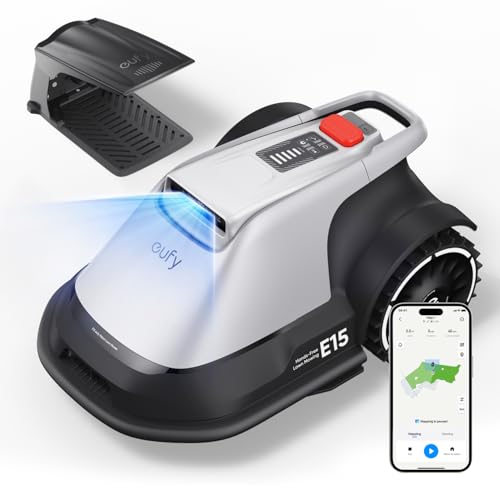
eufy E15
Best camera-navigation mowerNavigates by camera rather than satellite, so tree cover and narrow side yards do not break positioning the way they can on a satellite-only mower.
Check price on AmazonAffiliate link. Price and stock change constantly, so we show them only on Amazon.
- Vision-based navigation
- No perimeter wire
- Auto mapping
- Works under tree cover where satellite mowers struggle
- Wire-free setup
- Newer platform with a shorter track record
- Camera navigation slows in low light
Bottom Line
Choose a robot lawn mower by measured yard fit, boundary recovery, slope capability, safety, and local service. A cheaper mower that cannot recover from a boundary or signal problem is not a bargain.
Sketch the yard and identify every boundary, slope, signal, and safety constraint before comparing models.
FAQs
Do robot lawn mowers need boundary wire?
Some use physical boundary wire, while others support virtual boundaries through satellite positioning or related systems. Verify the exact model and local installation conditions.
Can robot lawn mowers handle slopes?
Some are designed for slopes, but the limit varies by model and surface. Compare the manufacturer's rating with your steepest wet and uneven section.
Are robot lawn mowers safe around pets?
They include safety features, but pets and children still require supervision. Follow the model's scheduling, blade, lift, wildlife, and obstacle guidance.
Primary Sources
Still deciding? Our top pick above, the Segway Navimow i110N, is the one we'd point you at.