Is the Sphero RVR+ Worth It?
The Sphero RVR+ is worth buying for students in grades 6 to 12 who plan to move past block coding. That means text programming or custom robotics hardware. Sphero lists the single RVR+ at $339.00, and it offers 12-robot and 18-robot class packs that maintain that exact unit price. The investment pays off when students use its universal expansion port to connect external microcontrollers or write scripts in JavaScript and Python.
The robot does not fit early-elementary grades or classrooms that only intend to teach simple block coding. Sphero lists the RVR+ for grades 6 to 12. If you only need introductory block coding, the $339.00 unit price buys hardware capabilities your curriculum will leave untouched.
Sphero states that the RVR+ works with no assembly required, operating straight out of the box so students can connect and program immediately.
Sphero RVR+ Specs and Price Table
Sphero publishes hardware dimensions, sensors and pack pricing on its product page. All figures in the table below reflect listings from the Sphero RVR+ product page checked on November 15, 2026.
The table outlines the core hardware specifications, connectivity modes, supported platforms, and available packaging tiers for individual buyers and school districts.
| Detail | What Sphero lists |
|---|---|
| Single robot price | $339.00 |
| 12-robot class pack price | $4,068.00 (12 robots at $339.00 each, supports 24 students) |
| 18-robot class pack price | $6,102.00 (18 robots at $339.00 each, supports 36 students) |
| Target grade band | Grades 6 to 12 |
| Playtime and battery | 2 hour playtime, with a removable, rechargeable and swappable battery |
| Sensors | Color sensor, light sensor, infrared (IR), gyroscope, accelerometer |
| Expansion and connectivity | Universal expansion port, Bluetooth communication, infrared communication |
| Device compatibility | Chrome, Mac, PC, iOS, Android, Kindle |
| Robot dimensions | 7.24 in long x 8.5 in wide x 4.5 in high |
| Product SKU | SKU 940-0635 |
How You Program the Sphero RVR+
Students program the Sphero RVR+ using the Sphero Edu application or the Sphero Edu Web App across three progressive coding environments. Sphero lists Draw, Blocks, and Text coding modes inside the application, allowing learners to begin with drag-and-drop logic before transitioning directly to JavaScript and Python. Sphero lists Chrome, Mac, PC, iOS, Android and Kindle as supported devices.
Classrooms managing strict software restrictions can deploy the browser-based Sphero Edu Web App without downloading local application files. Sphero notes that the web version provides faster implementation for schools facing software install limits on Chromebook, macOS, or Windows machines. For advanced learners, the Sphero RVR+ press release highlights access to the Sphero Public software development kit (SDK) and application programming interface (API) libraries.
Hardware customization occurs through the built-in universal expansion port, which interfaces with third-party computing boards. Sphero says the included customizable expansion plate connects most third-party hardware, including Raspberry Pi and Arduino. Sphero's classroom examples include applying the Pythagorean theorem with sensor data, learning about autonomous vehicles and building delivery bots.
What Changed From the Original RVR
Sphero announced the Sphero RVR+ in a November 15, 2022 press release as an updated mobile robotics platform designed for middle school, high school, and makerspace environments. Sphero says it redesigned the gearbox to improve torque, durability and payload capacity, with payload up to 1 kilogram.
Sphero's announcement states that the rechargeable battery is improved, swappable, and provides increased battery life. Each robot includes a key to unlock the battery compartment.
Sensor performance was updated with an enhanced onboard color sensor to improve color accuracy in programming. Sphero says RVR+ is drivable out of the box with no assembly.
Sphero RVR+ Classroom Cost at 12 and 18 Robots
Calculating the total cost of a classroom rollout requires looking at Sphero's published single-unit and class pack prices. Sphero prices the 12-robot pack at $4,068.00 and the 18-robot pack at $6,102.00 on its storefront. The arithmetic checks out: 12 x $339.00 equals $4,068.00 and 18 x $339.00 equals $6,102.00, so the listed pack prices show no per-robot discount.
Sphero specifies that the 12-robot pack supports 24 students, while the 18-robot pack supports 36 students, which establishes an assumed pair-programming structure of two students per robot. Dividing $4,068.00 by 24 students yields a cost of $169.50 per student seat. Similarly, dividing $6,102.00 by 36 students yields the identical figure of $169.50 per student seat.
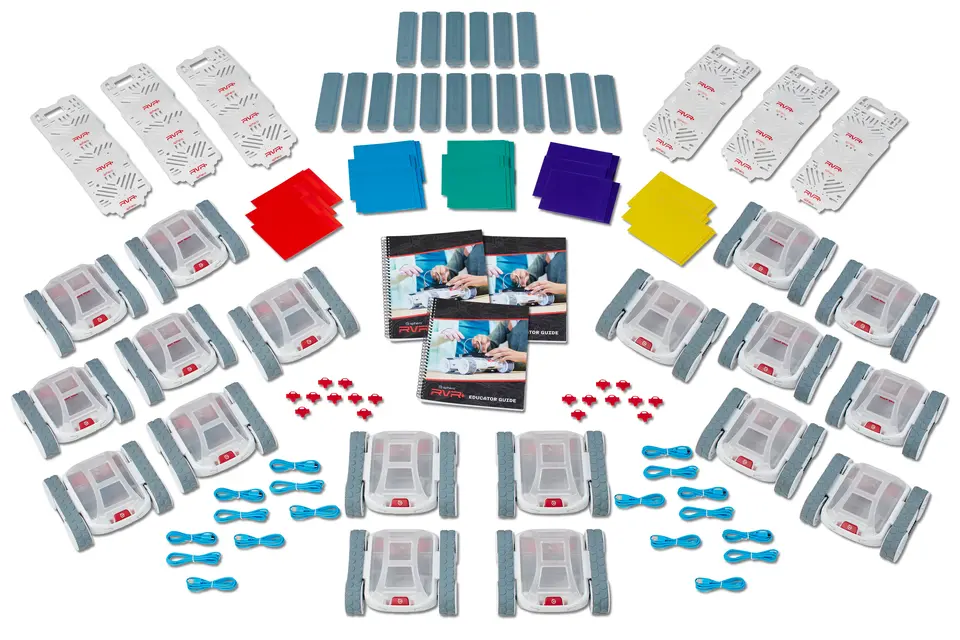
Sphero includes extra instructional materials inside the class bundles to support teaching staff. A single robot package provides one robot, one battery, one key, one USB-A charging cable, one mounting plate, one Blueprint plate and five color cards. The multi-packs scale these items to the robot count. The 12-pack adds two quick start guides, two getting started cards and two Educator Guides to its 12 sets (60 color cards). The 18-pack has 18 sets (90 color cards) and three of each guide. Sphero's pages list no subscription fee for the app. Schools can use the Get a Quote option and the Funding and Grants link on Sphero's site.
Who Should Pick Something Else
Early-elementary classes should look past the Sphero RVR+. Sphero targets grades 6 to 12. In those classrooms, the text coding and the expansion port may go unused at $339.00 a robot.
Programs operating under strict per-seat spending constraints may also want to evaluate other robotic options. If your classroom prioritizes mechanical assembly or budget-friendly coding foundations, review our guide to the best STEM robotics kits to compare platforms across different price bands. For other classroom kits, read our Makeblock mBot review and our VEX IQ vs LEGO Spike comparison.
Our verdict would change if Sphero adjusted its pricing structure, added built-in volume discounts on multi-robot packs, or introduced official curriculum support for elementary grade bands. It would also change if Sphero altered device compatibility or discontinued browser access on the Sphero Edu Web App.
Bottom Line
The Sphero RVR+ is a capable choice for middle and high school classrooms ready to program in Python and JavaScript or connect external maker boards. It is not suitable for early-elementary learners or schools needing a low-cost starter kit. This recommendation rests on hardware specifications and prices published on the official Sphero website as of November 2026. To verify current inventory and order for your school, review the Sphero RVR+ product page.
Check live stock and official pack pricing directly on the Sphero RVR+ product page.
FAQs
Is the Sphero RVR+ worth it?
Yes, the Sphero RVR+ is worth it for middle and high school programs that require text-based coding in JavaScript and Python or need to attach external hardware like Raspberry Pi and Arduino, among other options. At $339.00 per unit, it provides an all-in-one mobile platform with live sensors and swappable batteries that requires no mechanical assembly.
Does the Sphero RVR+ work on Mac or iPad?
Sphero lists Mac and iOS as supported systems and does not name iPad, so confirm iPad support with Sphero on the Sphero RVR+ product page before buying a class set.
How do you charge the Sphero RVR+?
You charge the Sphero RVR+ using the included USB-A charging cable connected to its removable and rechargeable battery. Sphero includes a battery compartment key in the box, though Sphero does not publish a specific charging duration.
What do I need to start with the Sphero RVR+?
You need the Sphero RVR+ robot, a compatible device running the free Sphero Edu app or Chrome browser for the Sphero Edu Web App, and the included USB-A charging cable. The single-unit box includes one robot, one swappable battery, one battery key, one mounting plate, one Blueprint plate, and a set of five color cards.
What coding languages does the Sphero RVR+ support?
The Sphero RVR+ supports Draw, block-based coding, JavaScript, and Python through the Sphero Edu application. Advanced students can also use the Sphero Public SDK and API libraries to program custom routines and interface with third-party microcontrollers.
How much does the Sphero RVR+ cost?
Sphero lists a single Sphero RVR+ at $339.00 on its website. Sphero also sells a 12-robot class pack for $4,068.00 (supporting 24 students) and an 18-robot class pack for $6,102.00 (supporting 36 students), which both work out to $169.50 per student seat without any per-unit pack discount.