Narwal Flow 2 at a Glance
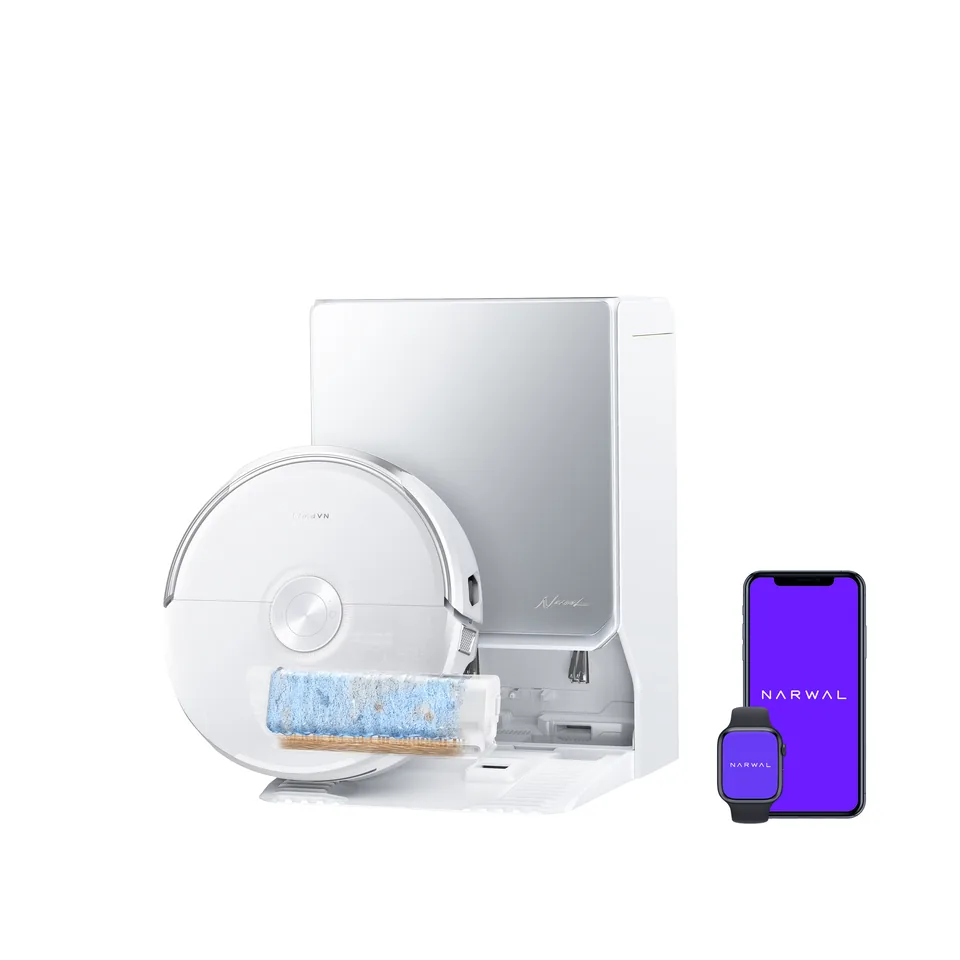
The Narwal Flow 2 is a 2026 flagship robot vacuum and mop that pairs a high-suction motor with a self-cleaning track mop and a vision-language AI system for navigation. Narwal builds it as the successor to the original Flow, keeping the self-rinsing mop concept but adding a camera-driven object-recognition layer on top.
Narwal unveiled the Flow 2 at CES 2026 and opened pre-orders on April 13, 2026, running through April 28 at a promotional $1,099.99 against a $1,499.99 MSRP. As of this review, Narwal's own store lists it at $1,299.99, so treat any of these three numbers as accurate depending on when you're buying.
It competes directly with other 2026 flagship robot vacuums in the $1,000 to $1,600 range. That group includes the Roborock Qrevo Edge 2 and the Dreame X50 Ultra, which we compared against the MOVA MOBIUS 60.
Narwal also builds out the smart-home side of the robot. The Flow 2 works with Siri, Alexa, and Google Assistant, plus Narwal's own Hey Nawa voice assistant and a NarGPT chat feature inside the app for asking the robot questions directly.
- 31,000 Pa suction, manufacturer-rated (not independently lab-measured)
- FlowWash self-rinsing track mop, 7-12 N downward pressure
- Hidden LiDAR plus dual 1080p cameras and a Vision Language Model for navigation
- Valuables Protection: flags small items like keys and wallets before cleaning over them
- Self-emptying dock with hot-water mop wash and warm-air drying
- $1,499.99 MSRP, sold as low as $1,099.99 at launch and $1,299.99 at review time
Navigation and AI Obstacle Avoidance
The Flow 2 navigates with an embedded LiDAR sensor built low into the chassis rather than a raised turret, backed by dual 1080p RGB cameras and what Narwal calls its VLM Omni Model. Narwal brands the combined system TwinAI Obstacle Avoidance, and markets its object recognition as effectively unlimited rather than tied to a fixed preset list.
An onboard AI processor handles most of that recognition on the robot itself, which Narwal says lets it react to obstacles in real time instead of waiting on a cloud round-trip. Independent coverage has reported the system can flag household items down to roughly 5 millimeters across, small enough to catch coins, screws, and similar clutter that many robot vacuums simply drive over.
In Vacuum Wars' obstacle-course testing, the Flow 2 avoided 20 of 24 planted obstacles, beating that outlet's 16-object category average. Its three-month home test backed that up in daily use, reporting the robot never once got stuck on a cable, a first for that reviewer's household.
Mopping System and Self-Cleaning Dock
FlowWash is Narwal's name for the Flow 2's self-rinsing track mop, a flat-loop belt that scrubs the floor and washes itself with hot water during the same cleaning run. Narwal's product page lists 7 to 12 newtons of downward mop pressure and an automatic 12 mm lift over carpet. A 16-nozzle rinsing system flushes dirty water out of the mop loop as it works.
Narwal's own launch materials cite mop-scrubbing water as hot as 140°F, up from the original Flow's 113°F. The product page separately lists the dock's AI-adaptive wash cycle running 113°F to 176°F, with 104°F warm-air drying afterward. The dock also self-empties into a 2.5-liter disposable bag Narwal rates for up to 120 days between changes.
FlowWash also includes EdgeReach, a mop extension Narwal says delivers millimeter-level edge cleaning along baseboards, a spot flat mop pads often skip entirely. The mop lifts 12 mm automatically once the robot detects carpet, so it doesn't drag a wet pad across rugs mid-run.
Vacuum Wars' lab testing found the mop underwhelming out of the box: 67.5 points on dried stains against a 108-point category average, and 34 against a 94-point average on coffee stains. A firmware update pushed during setup changed that picture. The same outlet's three-month real-world test called the post-update mopping results the cleanest it had seen from a robot vacuum, with no streaking or residue.
Vacuuming, Pet Hair, and Long-Term Reliability
The Flow 2 handled pet hair well in independent testing, picking up 88% of flattened pet hair and 84% of embedded sand from carpet, both above that reviewer's category averages. It also recorded zero brush-roll tangling, against a 26% average tangle rate across the rest of the tested field. Vacuum Wars credited that to the robot's tapered anti-tangle roller and side-brush design.
Narwal pairs the 31,000 Pa suction rating with what it calls CarpetFocus technology. It's aimed at keeping suction consistent when the robot rolls from hard flooring onto carpet, instead of losing power at the transition. That combination is likely a factor in the strong sand and pet-hair scores above, though Narwal hasn't published an independent CarpetFocus lab breakdown of its own.
Over three months of daily use in a family home, the same reviewer needed to step in only twice. Once, paper jammed the brush; the other time, the robot got stuck under a chair. The dock stayed trouble-free too, with no hair clogging despite the robot's modest 300 mL onboard dustbin.
The app is the clearest weak point across both reviews. Testers described it as unintuitive, and found the voice announcements the robot plays after a drying cycle difficult to turn off through the app's settings.
Valuables Recognition: What It Actually Does
Valuables Protection is Narwal's name for the Flow 2's small-object safety feature, which uses the VLM camera system to spot items like keys, wallets, and remotes before the robot vacuums near them. Narwal says the robot keeps a minimum 5 cm distance from a recognized valuable rather than driving over it. It can also pin the item's location on the in-app map, so an owner can find a misplaced object later.
Real-world reliability is the catch. Vacuum Wars flagged valuables-mapping as inconsistent in practice, listing it as one of the review's specific downsides even though the underlying obstacle-avoidance behavior around those same items tested well.
The Flow 2 also ships two related, more situational modes. Baby Care Mode quiets the robot and has it recognize toys near a crib, and Pet Care Mode restricts cleaning around a pet's zone and can help locate a pet on the map. Treat all three as convenience layers on top of the core navigation system, not a replacement for keeping fragile or important items somewhere the robot can't reach.
How the Narwal Flow 2 Compares
The Narwal Flow 2 wins the suction and small-object-recognition specs against its closest same-price rivals, but it isn't the only flagship worth cross-shopping at this budget. The Qrevo Edge 2 lists at the same $1,299.99 Narwal is currently charging, while the X50 Ultra undercuts both at roughly $1,050 MSRP. Buyers chasing a bigger discount should also see our Narwal Flow review, which covers the original model Narwal still sells well below the Flow 2's price.
Suction ratings across all three are manufacturer motor numbers, not independently measured pickup, so treat the Pa gap as directional rather than a guaranteed real-world difference. Mop architecture is the bigger practical split: Narwal and Dreame both use a single self-cleaning mop system, while Roborock's Edge 2 uses a pressure pad instead of a rinsing track. For flagship-tier picks beyond these three, see our full robot vacuum buyer guide.
| Criterion | Narwal Flow 2 | Roborock Qrevo Edge 2 | Dreame X50 Ultra |
|---|---|---|---|
| Suction (manufacturer-rated) | 31,000 Pa | 25,000 Pa HyperForce | 20,000 Pa |
| Navigation | Hidden LiDAR + dual cameras + VLM | RetractSense retractable LiDAR | LiDAR-based, no VLM object ID |
| Mop system | FlowWash self-rinsing track mop | Single 8 N pressure pad | Single self-cleaning roller mop |
| Standout feature | Small-object recognition, Valuables Protection | Low 3.14 in body for under-furniture access | 5-year warranty, 11.8 in hair-length rating |
| Price (MSRP) | $1,499.99 | $1,299.99 | ~$1,050 |
| Verdict | Best AI-driven object recognition | Best low-profile body | Best price-to-spec value |
Bottom Line
The Narwal Flow 2 earns its flagship price on suction and its camera-plus-LiDAR object recognition, which genuinely catches small clutter and flags valuables before the mop or vacuum reaches them. Mopping needed a firmware update to live up to its FlowWash pitch, the app frustrated both reviewers, and Valuables Protection itself isn't fully reliable yet. Buy it if strong vacuuming, low brush-roll tangling, and camera-based obstacle avoidance matter more than a polished app. Buy the Roborock Qrevo Edge 2 instead for a lower body and under-furniture reach, or the Dreame X50 Ultra if price is the deciding factor.
Confirm the Flow 2's current price on Narwal's own store before buying, since it has sold anywhere from $1,099.99 to $1,499.99 since launch.
FAQs
How much does the Narwal Flow 2 cost?
The Narwal Flow 2 lists at $1,499.99 MSRP. Narwal sold it for a promotional $1,099.99 during its April 2026 launch window and listed it at $1,299.99 on its own store at review time, so check the current price before buying.
Does the Narwal Flow 2 have LiDAR?
Yes. It uses an embedded LiDAR sensor built low into the chassis, combined with dual 1080p cameras and a Vision Language Model Narwal calls TwinAI Obstacle Avoidance.
What is Narwal Flow 2's valuables recognition feature?
Valuables Protection uses the robot's camera system to spot small items like keys and wallets, keep roughly 5 cm of clearance from them, and pin their location on the app's map. Independent testing found the feature useful in concept but inconsistent in practice, flagging valuables-mapping reliability as a real downside.
Is the Narwal Flow 2's mop any good?
It improved significantly after a firmware update. Early lab testing scored the out-of-box mop below category average on dried and coffee stains. A three-month real-world test after the update called the results the cleanest that reviewer had seen from a robot vacuum.
How does the Narwal Flow 2 compare to the Roborock Qrevo Edge 2?
The Flow 2 rates higher on manufacturer suction (31,000 Pa versus 25,000 Pa) and adds camera-based small-object recognition the Edge 2 doesn't have. The Edge 2 counters with a lower 3.14-inch body for under-furniture cleaning and a more established app, at the same $1,299.99 price Narwal currently lists.
Is the Narwal Flow 2 reliable long-term?
Early signs are positive. A three-month real-world test needed only two manual interventions, reported no dock hair clogs, and said the robot never got stuck on a cable. The app itself was still flagged as unintuitive in daily use.
Primary Sources
- Narwal Flow 2 — official product page
- PR Newswire — Narwal Launches Flow 2 Robot Vacuum with Vision Language Model (VLM) and Upgraded FlowWash Mopping System
- Vacuum Wars — Narwal Releases 2026 Flagship Flow 2 Robot Vacuum
- Vacuum Wars — Narwal Flow 2 Robot Vacuum and Mop Review: Innovative AI With a Few Tradeoffs
- Vacuum Wars — Narwal Flow 2 Review: 3 Months of Real-World Home Testing
- Roborock Qrevo Edge 2 official product page
- Dreame X50 Ultra — official product page