What Is Carbon Robotics?
Carbon Robotics is an agricultural robotics company based in Seattle, with manufacturing operations in Eastern Washington. It was founded in 2018 by Paul Mikesell, a University of Washington computer science graduate whose prior work included founding the storage company Isilon Systems and building infrastructure at Uber, before turning that neural-network and computer-vision background toward farming.
The company's flagship product is the LaserWeeder, a tractor-pulled implement that identifies individual weeds among row crops and destroys them with lasers rather than herbicide. Carbon Robotics has since expanded the line into the LaserWeeder G2 and describes itself as building "physical AI for agriculture," applying the same perception stack to other field tasks over time.
The LaserWeeder is one of the named commercial machines in our agricultural robots guide, which groups farm robots by task rather than brand, and in the weed control robots guide, which compares laser, mechanical, and spot-spray weeding methods.
How The LaserWeeder Actually Works
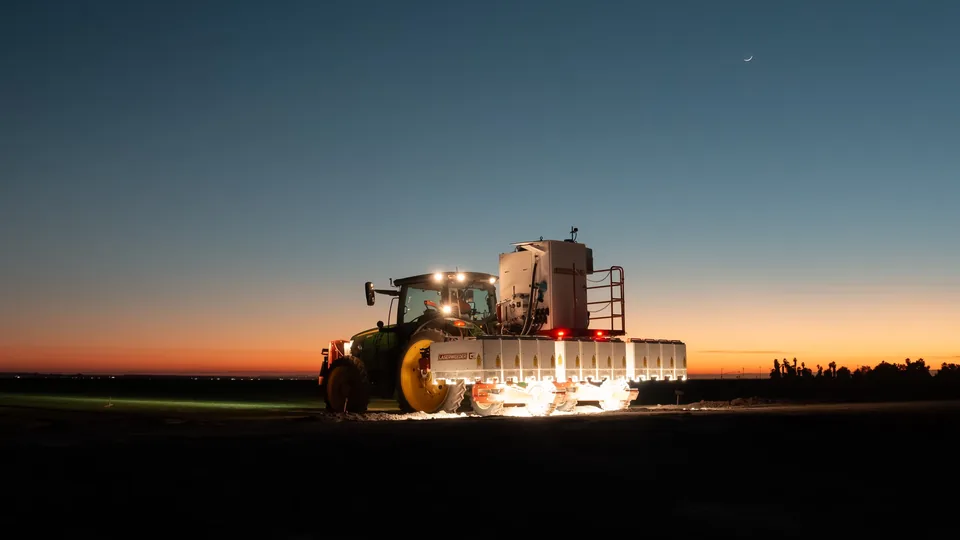
The LaserWeeder is pulled behind a standard tractor across a field. As it moves, an array of high-resolution cameras captures the crop row in real time and feeds the images to onboard GPUs running deep-learning models trained to tell the planted crop apart from weeds, even at close spacing and at driving speeds up to about 6 mph.
Once a weed is identified, the system aims a laser at the plant's growing point, or meristem, and applies a short burst of thermal energy. Carbon Robotics says this destroys the meristem so the weed cannot regrow, and the dead plant is left in the field as organic biomass within about 72 hours — with no chemicals sprayed and no soil disturbed by tillage.
That combination is what separates the LaserWeeder from other precision weeding approaches: spot-spray systems like John Deere's See & Spray still apply herbicide, and mechanical weeders cut or till the soil near the crop row, which risks root damage. The LaserWeeder's pitch is zero-chemical, zero-tillage weed elimination at row-crop scale.
LaserWeeder G2 Models And Specs
The current generation, the LaserWeeder G2, ships in five widths so growers can match the machine to their operation, from smaller diversified farms up to large-scale row-crop acreage. Carbon Robotics reports each laser module carries two 240-watt lasers, three cameras for sub-millimeter weed detection, LED lighting for night operation, and two NVIDIA GPUs processing against more than 100 trained crop models.
Independent reporting on the earlier LaserWeeder generation put throughput at roughly 4.7 million images processed per hour and up to 5,000 weeds killed per minute across the full machine width, with Carbon Robotics saying the G2 line is faster and lighter than the model it replaced.
| Model | Approx. width | Best fit |
|---|---|---|
| LaserWeeder G2 200 | Narrow | Smaller and specialty farms |
| LaserWeeder G2 300 / 400 | Mid-width | Diverse crop types, varied field layouts |
| LaserWeeder G2 600 | 20 feet | Flagship row-crop model |
| LaserWeeder G2 1200 / 1800 | 40–60 feet | Large-scale organic corn, soybean, and broadacre |
LaserWeeder Price And ROI
Carbon Robotics does not publish a single retail price, and the LaserWeeder G2 is sold through direct sales conversations rather than an online checkout. Industry reporting puts new G2 units in the roughly $1.4 million to $1.7 million-plus range depending on width and configuration — the G2 600 has been reported near $1.4 million, with the largest G2 1800 above $1.7 million — plus an annual support and software fee reported in the tens of thousands of dollars. Used units have appeared at auction for a small fraction of that, so any exact figure should be verified directly with Carbon Robotics before budgeting.
The company's own payback claim is a 1 to 3 year break-even on equipment built to last 7 to 10 years, driven mainly by cutting herbicide spend rather than labor. Carbon Robotics also reports up to an 80 percent reduction in weed-control cost and a 5 to 50 percent yield increase versus chemical weeding, figures it says are validated by grower and third-party trials.
Before treating any of those figures as guaranteed on your own farm, run the same discipline covered in the robotics ROI guide: measure your current herbicide and pass cost against a real quote, not a marketing average.
Paul Mikesell, Funding, And Growth
Paul Mikesell founded Carbon Robotics in 2018 after building the storage-systems company Isilon Systems and working on infrastructure teams at Uber, applying that computer-vision and distributed-systems background to a farm problem after prototyping a laser weeder in his own backyard.
Carbon Robotics has raised roughly $157 million across multiple rounds, most recently a $70 million Series D in October 2024 led by BOND with participation from NVIDIA's venture arm NVentures, Anthos Capital, and others, pushing its reported valuation to around $370 million. The company has said the fleet has eliminated more than 10 billion weeds globally since 2022 across more than 100 crop types in North America, Europe, and Australia, and has reported crossing $100 million in annual revenue.
Carbon Robotics sits alongside other AI-driven robotics companies we track outside the humanoid space, such as Field AI's physics-first navigation models — both apply deep learning to unstructured, real-world environments rather than a factory floor.
How The LaserWeeder Compares
Within row-crop weeding, the LaserWeeder's main commercial rivals use different mechanisms: John Deere's See & Spray and Ecorobotix's ARA both spot-spray herbicide only onto detected weeds rather than eliminating chemicals entirely, while Naio Technologies builds smaller autonomous mechanical weeders for narrower rows. The practical choice among them usually comes down to whether a farm wants to cut chemical volume (spot-spray) or eliminate it (laser), and how the equipment cost compares to the acreage it needs to cover in season.
See the full field-by-field comparison, including harvesting and other farm-task robots, in the agricultural robots guide, and the discrimination-accuracy framework for judging any weeding robot in the weed control robots guide.
Growers comparing options across autonomous agricultural robots and dedicated weed control robots face a clean division between total chemical elimination and targeted reduction. The LaserWeeder G2 earns the top rank for large-scale operations committed to eliminating chemicals entirely regardless of equipment cost. That multi-million-dollar investment stops herbicide spend and prevents soil disruption from tilling.
Second rank goes to precision spot-spraying. Ecorobotix ARA cuts chemical volume by up to 95 percent for vegetable crops, while John Deere See & Spray reduces herbicide use on broadacre farms already running Deere spray rigs. Third rank belongs to Naio Technologies, whose mechanical weeders like the Oz and Dino deliver chemical-free cultivation for market gardens and vineyards at prices starting around $30,000, far below the LaserWeeder's entry cost.
| Approach | Chemical Use | Reported Price | Best Fit |
|---|---|---|---|
| Carbon Robotics LaserWeeder G2 (laser-directed thermal weeding) | Zero chemicals: eliminates herbicide entirely | Roughly $1.4 million (G2 600) to $1.7 million+ (G2 1800), plus an annual software fee reported in the tens of thousands of dollars | Large-scale row-crop operations wanting to eliminate herbicide entirely without tillage |
| John Deere See & Spray (camera-guided spot-spraying) | Reduces herbicide volume on detected weeds only | Not published here; verify directly with John Deere | Broadacre row-crop operations wanting to cut chemical volume using existing spray equipment |
| Ecorobotix ARA (precision micro-spot spraying, a 2.4 by 2.4 inch target zone) | Up to 95% herbicide reduction versus blanket spraying | Not published here; see our Ecorobotix ARA review for pricing factors | Vegetable and specialty crop growers wanting steep chemical cuts without a laser rig |
| Naio Technologies (Oz, Dino, Ted: autonomous mechanical between-row cultivation) | Zero chemicals: physical cultivation tools only | Reported near $30,000 (Oz), $200,000 to $300,000 (Dino), or near €175,000 target (Ted) | Small market gardens (Oz), larger vegetable beds (Dino), and vineyards (Ted) wanting autonomous mechanical weeding |
Bottom Line
Carbon Robotics' LaserWeeder is one of the few agricultural robots with real commercial scale: a tractor-pulled machine that uses cameras, AI, and lasers to kill weeds without chemicals, sold in five G2 widths at prices reported from roughly $1.4 million and up. Founder Paul Mikesell has raised about $157 million behind it, and the company reports over 10 billion weeds eliminated and $100 million in annual revenue. Verify current pricing, support fees, and ROI directly with Carbon Robotics before budgeting a purchase.
Compare the LaserWeeder against other named farm robots in the agricultural robots guide, and check the discrimination and chemical-reduction math in the weed control robots guide before requesting a quote.
FAQs
What is Carbon Robotics?
Carbon Robotics is a Seattle-founded agricultural robotics company, started in 2018 by Paul Mikesell, that builds the LaserWeeder — a tractor-pulled machine that uses cameras and AI to identify weeds and kill them with lasers instead of herbicide.
How does the LaserWeeder work?
Cameras and onboard AI scan the crop row as the machine is towed through the field, telling crop plants apart from weeds. A laser then targets each weed's growing point (meristem) with a burst of thermal energy, destroying it without chemicals or tillage.
How much does the Carbon Robotics LaserWeeder cost?
Carbon Robotics does not publish an official retail price. Industry reporting puts new LaserWeeder G2 units at roughly $1.4 million to $1.7 million or more depending on width and configuration, plus an annual support fee reported in the tens of thousands of dollars. Confirm exact pricing directly with Carbon Robotics.
Who founded Carbon Robotics?
Paul Mikesell founded Carbon Robotics in 2018. He previously co-founded the storage company Isilon Systems and worked on infrastructure at Uber before applying his computer-vision background to weed control.
How much funding has Carbon Robotics raised?
Carbon Robotics has raised roughly $157 million total, including a $70 million Series D in October 2024 led by BOND with NVIDIA's NVentures participating, at a reported valuation near $370 million.