What Is HAI Robotics?
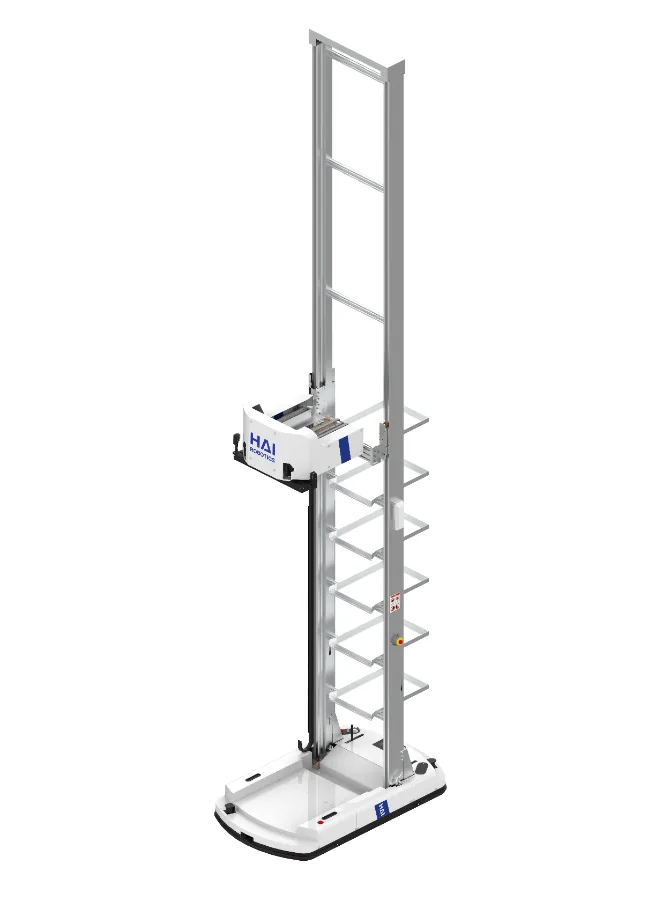
HAI Robotics (also known by its Chinese name, Hairou Innovation) is a warehouse automation company founded in Shenzhen in 2016 by cofounder and CEO Richie Chen. The company created the autonomous case-handling robot, or ACR, category with its HAIPICK system, which it says was the world's first robot of this kind when it launched in 2015.
Instead of moving entire shelving units to a picker like Amazon's Kiva-derived robots, a HAIPICK robot climbs a fixed storage rack itself, using a mast and gripper to pull individual totes or cartons and deliver them to a goods-to-person picking station. HAI Robotics markets this as a way to raise storage density and throughput without rebuilding a warehouse's racking.
This page covers how HAIPICK works, the specs on its A42 and A42T robot lines, what funding and deployment data is publicly confirmed, and how HAIPICK compares with other warehouse robots we cover.
| Attribute | HAI Robotics HAIPICK | Note |
|---|---|---|
| Founded | 2016 (Shenzhen, China) | Cofounder and CEO: Richie Chen |
| Category | Autonomous Case-Handling Robot (ACR) | HAI Robotics says it created this category in 2015 |
| HAIPICK A42 reach | Up to 6 m (19.7 ft) | Manufacturer-published spec |
| HAIPICK A42T reach | Up to 12 m (39 ft), 30 kg payload | Telescopic variant, manufacturer-published |
| A42 max speed | 1.8 m/s | Manufacturer-published |
| Deployments | 500+ projects, 30+ countries (2025-2026 company figures) | Company-reported, not independently audited |
How The HAIPICK ACR System Works
A HAIPICK robot is a mobile lift unit that drives to a storage rack, extends a mast, and uses a gripper or forked arm to pull a tote or carton directly off a shelf slot, then carries it to a picking or packing station. Because the robot itself climbs and reaches, HAI Robotics can increase storage density inside an existing racking footprint rather than requiring shelves designed to be lifted and carried, which is how Amazon-style goods-to-robot systems work.
The A42 series, HAI Robotics' core line, reaches up to 6 m and can carry multiple totes or cartons per trip, letting it continuously feed a picking station instead of making single-item runs. The taller A42T telescopic variant extends that reach to roughly 12 m for warehouses with high-bay racking, at a lower per-trip payload of about 30 kg.
HAI Robotics positions HAIPICK for apparel, e-commerce, 3PL, retail, healthcare, electronics, and automotive parts warehouses. For the broader category this competes in, see our warehouse picking robots guide and autonomous mobile robots explainer.
- Robot climbs the rack itself to pick totes/cartons directly (no shelf-lifting required).
- A42: up to 6 m reach, multiple totes per trip, 1.8 m/s max speed.
- A42T: telescopic mast reaching up to 12 m, 30 kg payload.
- Deploys inside existing racking, expandable section by section as demand grows.
HAI Robotics Funding And Company History
HAI Robotics has raised capital across multiple rounds since its 2016 founding. Public reporting confirms a $15 million Series B+ round in March 2021, followed by combined Series C and D rounds totaling roughly $200 million announced in September 2021, with the C round led by 5Y Capital and the D round led by Capital Today, alongside existing backers including Sequoia Capital China and Source Code Capital. A further $100 million round was reported in mid-2022.
That funding history pushed HAI Robotics to unicorn status within about five years of founding, with reported valuations around $2 billion in press coverage. Reported deployment figures have grown from roughly 200 projects and 2,000 robots in 2021-era coverage to over 500 ongoing projects across 30-plus countries in more recent company statements, with offices reported in the U.S., Europe, Japan, Southeast Asia, Australia, Hong Kong, and Taiwan.
HAI Robotics has also announced integration partnerships with established materials-handling firms, including agreements with TGW Logistics and Dematic reported in late 2025 and January 2026, aimed at combining HAIPICK ACR hardware with those companies' warehouse-execution software. Treat all deployment counts and valuation figures as company or press-reported, not independently audited.
HAIPICK Pricing
HAI Robotics does not publish public list pricing for HAIPICK robots. Like most warehouse robotics vendors, it sells through a quoted, project-based process that factors in fleet size, rack height, integration with existing warehouse management software, and whether the deal is a purchase or Robots-as-a-Service (RaaS) subscription.
If you are evaluating cost, request a quote directly from HAI Robotics or an integration partner rather than trusting a third-party number, and compare it against the total-cost breakdown in our industrial robot cost guide.
How HAIPICK Compares To Other Warehouse Robots
HAIPICK's climbing-robot approach is a direct alternative to shelf-lifting goods-to-person systems popularized by Amazon Robotics, and to conveyor- or pallet-focused automated storage and retrieval systems (AS/RS). For the shelf-lifting model it competes against, see our Amazon Robotics explainer.
HAI Robotics is one of several Chinese warehouse and logistics robotics companies expanding internationally alongside firms like Geek+ and Quicktron. Our Chinese industrial robots guide covers that wider landscape, and our warehouse automation overview explains where ACR systems fit among AMRs, AS/RS, and conveyor automation.
The practical differentiator is footprint: HAIPICK can often be installed inside a warehouse's existing racking, while shelf-lifting systems typically need shelving purpose-built to be carried. That makes ACR systems attractive for retrofits, though the tradeoff is per-trip throughput versus a dedicated pod-storage design.
Bottom Line
HAI Robotics built the autonomous case-handling robot category with HAIPICK, a rack-climbing system that picks totes and cartons directly instead of lifting whole shelves. Backed by roughly $200 million-plus in disclosed funding and unicorn-stage valuation, the company reports hundreds of active deployments worldwide and recent integration partnerships with established materials-handling players. Pricing is quote-only, so treat any published deployment or valuation figure as company-reported until verified.
Compare HAIPICK against shelf-lifting and other warehouse robot approaches in our warehouse picking robots guide and Amazon Robotics explainer, and check our top robots for warehouse buying guide before requesting a quote.
FAQs
What is HAI Robotics?
HAI Robotics is a Shenzhen-based warehouse robotics company, founded in 2016, that created the autonomous case-handling robot (ACR) category with its HAIPICK system, which climbs storage racks to pick totes and cartons directly for warehouse fulfillment.
What is the HAIPICK ACR system?
HAIPICK is HAI Robotics' autonomous case-handling robot line. It drives to a storage rack, extends a mast, and pulls totes or cartons off shelf slots to deliver to a picking station, rather than lifting entire shelving units.
How high can a HAIPICK robot reach?
The core A42 series reaches up to 6 m (19.7 ft). The telescopic A42T variant extends to about 12 m (39 ft) for high-bay racking, carrying up to 30 kg per trip at that height.
Who founded HAI Robotics?
HAI Robotics was founded in 2016 by cofounder and CEO Richie Chen in Shenzhen, China.
How much does a HAIPICK robot cost?
HAI Robotics does not publish public pricing. Cost depends on fleet size, rack height, and software integration, and is quoted directly through the company or an integration partner such as TGW Logistics or Dematic.