L60 Pro Ultra at a Glance
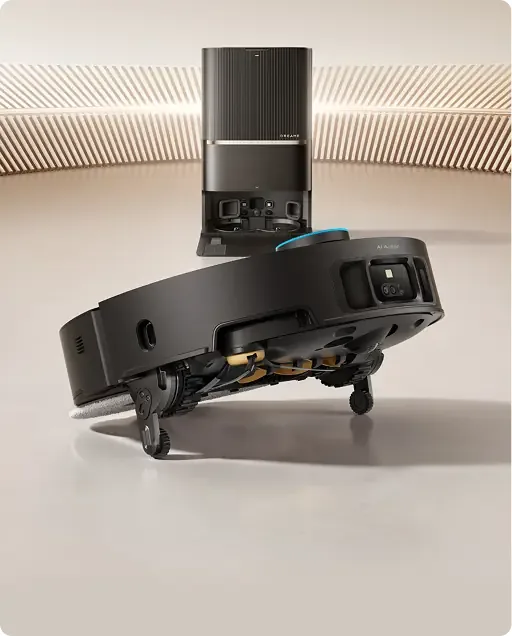
The L60 Pro Ultra sits at the top of Dreame's L60 lineup. That puts it a step above the earlier L50 Ultra, which held a leading spot on independent robot vacuum rankings for months. Dreame's L Series has traditionally sat in the mid-range, below the flagship X Series, and the L60 Pro Ultra pushes further into premium territory on both price and features.
Suction is rated at 35,000 Pa, and independent bench testing measured 1.14 kPa against a 0.99 kPa category average. Airflow scored 20 against a 17 average. Both numbers are comfortably ahead of typical mid-range results.
Its two standout features are a ProLeap threshold-climbing system and an AI-powered obstacle avoidance stack. That stack combines a camera, dual-laser 3D structured light, and LED illumination.
- 35,000 Pa suction, 1.14 kPa measured and airflow score of 20 in independent bench testing
- ProLeap threshold climbing: crossed a 51mm threshold in testing, rated for 88mm tiered thresholds
- HyperStream DuoBrush anti-tangle system with an extending side brush
- 89mm body height with retractable VersaLift LiDAR
- Dual spinning mop pads with 40°C (104°F) heated-water mopping
- $1,399.99 list price, frequently discounted to around $1,189.99
Vacuuming and Carpet Deep-Clean Results
The L60 Pro Ultra's suction and airflow numbers translated into strong real-world cleaning. In a carpet deep-clean test that embeds sand into medium-pile carpet, it removed 90% of the debris. That beats the 78% category average and marks a meaningful step up from the Dreame L50 Ultra's own 76% on the same test.
Pet hair pickup reached 93.5% in a 2.5-inch flattened hair test, against an 82.2% category average. That falls short of the L50 Ultra's perfect 100% score. Even so, 93.5% still ranks among the stronger results tested.
The HyperStream DuoBrush system uses two brushes that rotate against each other to funnel hair into the dustbin. It backed the pickup number up with a perfect 0% hair-tangle score in a 7-inch hair test, against a 26% category average.
Obstacle Avoidance and Threshold Climbing
Obstacle avoidance was a major strength. The L60 combines an AI-powered camera with dual-laser 3D structured light and LED illumination assistance. It avoided 22 of 24 test obstacles, beating the 15.7 category average and improving on the already-strong L50 Ultra's own score of 20.
Threshold climbing set an even clearer high point. Dreame's new ProLeap hardware is rated to clear tiered thresholds up to 88mm, with a first-step rating of 45mm. In testing, the L60 Pro Ultra crossed a single threshold measuring 51mm, exceeding its own official rating and doing so on the first attempt.
That 51mm result more than doubled the L50 Ultra's 25mm on the same test, a gap wide enough to change which robot a household with raised thresholds should buy. The Pro Ultra is also the only model in the L60 family rated for thresholds this tall. Everything else in the lineup tops out lower: the standard L60 Ultra at 60mm, the rest of the family at 40mm.
A Low-Profile Design Built Around VersaLift
At 89mm tall, or about 3.5 inches, the L60 Pro Ultra stands lower than both the 97mm category average and the L50 Ultra's 99mm. Dreame's VersaLift system retracts the LiDAR turret into the body when it senses low-clearance furniture. That lets the robot reach spaces many taller competitors cannot.
That retracting design is also the reason navigation efficiency landed slightly below average in testing, at 0.64 square meters per minute against a 0.71 average. The trade-off buys real access under furniture in exchange for a small navigation-speed penalty.
For a home with a lot of low beds, sofas, and cabinets, that trade will usually be worth it. For a home with mostly open floor space and little low furniture, a taller robot with faster navigation may clean the same square footage more quickly. Measuring the actual clearance under a home's furniture, rather than guessing from memory, is the fastest way to settle which trade-off applies before buying.
Mopping and Dock Automation
The L60 Pro Ultra mops with dual spinning pads and heats water to 40°C (104°F) to help loosen stubborn messes, a feature the L50 Ultra does not have. In a dried-stain removal test it scored 120 points against a 108-point category average.
Water usage was the weak point. The robot recorded 1.6 grams of water residue in testing, against a 1.07-gram average and the L50 Ultra's 0.3 grams. That gap held steady across the low, medium, and high flow settings rather than narrowing at a lower setting.
Combined into one mopping score, the L60 Pro Ultra reached 18.7 points. That falls below the 20.3-point category average and well behind the L50 Ultra's 27.4. The dock itself is otherwise fully automated. It empties the dustbin, washes pads with 212°F water, and dries them with hot air.
It also mixes detergent automatically and can remove the mop pads entirely for vacuum-only runs on carpet. That last feature protects carpet fiber from any chance of contact with a damp pad, a detail some rival docks skip.
Battery Life and What It Means Day to Day
Battery efficiency also landed below average, at 1.48 square meters cleaned per 1% of battery against a 1.56 average and the L50 Ultra's 1.72. Dreame fits a larger 6,400 mAh battery here, up from 5,200 mAh on other L60 models. That upgrade appears to offset the extra power draw from heated-water mopping rather than eliminate it entirely.
Combined with the slightly lower navigation efficiency, estimated single-charge coverage reached about 1,020 square feet, well under the 1,170-square-foot average and the L50 Ultra's own 1,277 square feet. A large home may need a mid-run recharge stop the L50 Ultra would not.
Most homes will not notice this in daily use, since the robot's recharge-and-resume feature picks a cleaning run back up where it left off automatically. The gap becomes more than a rounding error mainly on a very large or heavily carpeted floor plan, where extra recharge stops add real time to a single cleaning run.
How the L60 Pro Ultra Fits Dreame's Own Lineup
Dreame now sells two very different flagship personalities under similar prices: the mobility-first L60 Pro Ultra and the mopping-first L50 Ultra. A buyer who has not decided which matters more should start with their home's actual floor plan rather than the spec sheet.
A home with raised thresholds between rooms, low furniture that traps dust, and pets that shed heavily plays to the L60 Pro Ultra's strengths directly. A home that is mostly open hard flooring with light furniture plays to the L50 Ultra's mopping and battery advantages instead.
Neither model replaces the other across the board, which is unusual inside one manufacturer's own lineup. Most brands position a step-up model as a strict upgrade. Dreame's L60 Pro Ultra genuinely trades away mopping quality and battery life for mobility gains, not just a higher price tag. That clear trade beats any marketing claim that one model simply outperforms the other on every measure.
Who Should Buy the L60 Pro Ultra
A household with raised thresholds, low furniture, and pets is the clearest fit. The L60 Pro Ultra's threshold climbing and obstacle avoidance both rank near the top of any robot vacuum tested, and its low profile reaches under furniture a taller flagship cannot.
A household that mops more than it vacuums, or that has mostly hard flooring, should look at the cheaper L50 Ultra instead. Its mopping score is meaningfully higher and its battery lasts longer per charge, at the cost of the L60 Pro Ultra's threshold-climbing and obstacle-avoidance gains.
A firmware update that tightens the mop's water-flow control at low settings would close the L60 Pro Ultra's clearest weakness. The fix sits entirely in software rather than the pump or nozzle design. It would not require touching the hardware that makes its obstacle handling and threshold climbing so strong.
Where To Buy
The models below are the ones we point readers at, listed in the order we would consider them.

Dreame L60 Pro Ultra
Best for high thresholdsNo other robot in this category gets over thresholds this tall, but you give up some under-furniture cleaning compared to rivals with a lower body.
Check price on AmazonBottom Line
The Dreame L60 Pro Ultra earns a very high position among tested robot vacuums on the strength of its threshold climbing, obstacle avoidance, carpet deep cleaning, and low-profile design. Its mopping performance and battery efficiency both land below the category average, real trade-offs rather than dealbreakers, and both are outperformed by its own cheaper L50 Ultra sibling. For a home with raised thresholds, low furniture, and pets, the L60 Pro Ultra's mobility gains are hard to match at any price, flagship or otherwise.
Weigh the L60 Pro Ultra's below-average mopping score against how much of your floor is actually carpet versus hard flooring before paying the premium over the L50 Ultra.
FAQs
Is the Dreame L60 Pro Ultra worth it?
For a home with raised thresholds, low furniture, or pets, yes. It posted near-top-of-field obstacle avoidance and threshold climbing in independent testing, though its mopping and battery efficiency both land below the category average and below its own cheaper sibling.
How does the L60 Pro Ultra compare to the L50 Ultra?
The L60 Pro Ultra improves on carpet deep cleaning (90% versus 76%), obstacle avoidance (22 versus 20 of 24), and threshold climbing (51mm versus 25mm). The L50 Ultra scores higher on mopping (27.4 versus 18.7) and battery efficiency (1.72 versus 1.48).
How good is the L60 Pro Ultra's obstacle avoidance?
It avoided 22 of 24 test obstacles using an AI camera, dual-laser 3D structured light, and LED illumination, well ahead of the 15.7 category average and its own predecessor's score of 20.
Can the Dreame L60 Pro Ultra climb thresholds?
Yes. It crossed a 51mm threshold in testing, exceeding its own 45mm first-step rating, and is rated for tiered thresholds up to 88mm, the highest rating in the L60 family.
Does the L60 Pro Ultra fit under low furniture?
Yes. At 89mm tall, it stands lower than both the category average and the L50 Ultra, thanks to a VersaLift system that retracts its LiDAR turret when it detects low-clearance furniture nearby.
Primary Sources
Still deciding? Our top pick above, the Dreame L60 Pro Ultra, is the one we'd point you at.