What a Yomi Dental Robot Costs
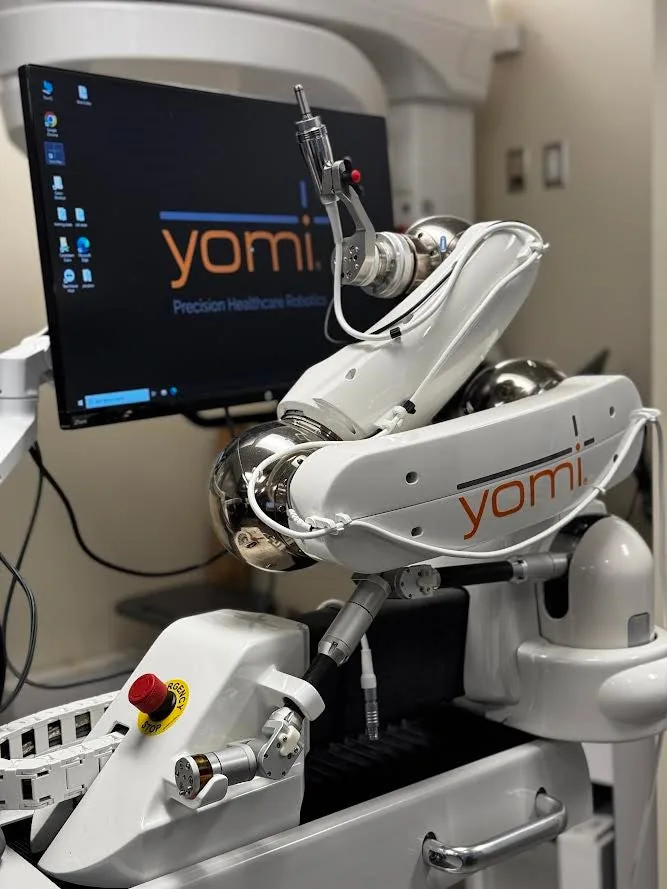
The only named Yomi purchase price in print is about $175,000. It was paid in May 2020, for a system configured for full-arch work. The Academy of General Dentistry (AGD) reported it in April 2023 and attributed the figure to Dr Bruce A. Smoler, an early adopter. Treat it as one buyer's configuration in one year. It is not a list price.
Neocis sells Yomi in modules, so a single number was never going to hold. AGD reported that a practice focused on single implants can buy the single-implant module alone. Full-arch capability adds software on top. The same report says a monthly subscription became available in the first quarter of 2023, and no rate for it has been published since. A subscription changes what you should ask for: a total first-year figure rather than a machine price.
The used market adds one more data point, far below the capital figure. Atlas Resell Management lists a pre-owned 2017 Yomi at $35,000, with a laptop, calibration tool, and the accessories in its photos. What we see readers get wrong most often is reading a listing like that as the market price. A nine-year-old unit comes with no manufacturer service contract, no current software, and no training. That is a different product.
The Four Cost Lines behind a Yomi Quote
A Yomi quote has four lines. Only the first ever appears in coverage of the system. Ask for all four as a single first-year total, because three of them repeat every year and the capital line does not.
Training is the line documented in the most detail, and it is short. Neocis chief executive Alon Mozes told AGD that training runs two days on site, covering dentists, assistants, and implant coordinators, with support through the first cases afterwards. Mozes put fluency at 20 to 30 cases. One clinician in the same report went from 90 minutes per case at the start to under 10 minutes to place the implants.
- Capital or subscription. Either an outright purchase, reported at about $175,000 for a full-arch configuration in 2020, or the monthly programme Neocis introduced in early 2023 and has never priced publicly.
- Per-case consumables. Every case uses a patient splint, a magnetically attached fiducial array, and drills. Neocis publishes no price for any of them, so this line exists only on your quote.
- Service and software. Surgical robots in other specialties carry annual service contracts near 10 to 12 percent of capital. Neocis publishes nothing comparable, so the service term is a question to ask rather than a figure to assume.
- Training and ramp. Two days on site, plus the 20 to 30 cases it takes to reach speed. Chair time per case runs longer through that stretch, so your schedule carries fewer patients.
FDA Cleared and FDA Approved Are Different Routes
Yomi holds FDA clearance under section 510(k). That is a different regulatory route from FDA approval, and the two words are not interchangeable. A 510(k) clearance means the FDA agreed the device is substantially equivalent to one already legally on the market. Premarket approval (PMA) is the heavier route, and it requires clinical evidence of a device's own safety and effectiveness. Yomi has never held a PMA, and no dental implant robot does.
The record is public and countable. Search the applicant name Neocis in the FDA 510(k) premarket notification database and 18 clearances come back. The first is K161399, for the Neocis Guidance System, on 22 December 2016. Later ones extended the system to full-arch treatment, bone reduction, additional materials, and new splints.
The most recent pair matters to anyone buying this year. K251835 cleared the Yomi Robotic System on 10 October 2025. K252376 cleared the Yomi S Robotic System on 28 October 2025. Neocis announced Yomi S on 17 November 2025 with a single-operator workflow, a smaller footprint, and a YomiPlan AI platform that segments anatomy from cone beam computed tomography (CBCT) scans automatically. If you are quoted on the older generation, ask what the step up to Yomi S costs before you sign.
How Yomi Compares to Navigation and Static Guides
A dental robot competes against two cheaper ways of controlling drill position. Dynamic navigation tracks the handpiece against the plan and shows the drill on a screen, leaving the dentist to hold the line. A robot adds physical haptic constraint, so the arm resists movement outside the planned position, angle, and depth.
The Institute of Digital Dentistry put the X-Guide dynamic navigation system from X-Nav Technologies at around $40,000 in its review, with a consumable X-Clip per case. That is roughly a quarter of the reported Yomi capital figure. In most practices it is the number a Yomi quote is weighed against. Static surgical guides are cheaper still, printed or milled per case, which is why a robot has to justify itself on volume rather than on accuracy alone.
| Approach | System cost | Per-case cost | What it controls | Best fit |
|---|---|---|---|---|
| Yomi robotic guidance | About $175,000 reported in 2020, or an unpublished subscription | Splint, fiducial array, drills. Not published | Physical constraint on position, angle, and depth | High-volume implant and full-arch practices |
| X-Guide dynamic navigation | Around $40,000 per Institute of Digital Dentistry | X-Clip per case | Screen guidance in real time, dentist holds the line | Practices wanting navigation without a robot arm |
| Static surgical guide | No system purchase | One printed or milled guide per case | Fixed drill path set before surgery | Low and moderate case volumes |
| Freehand placement | None | None | Operator experience only | Single simple cases in trained hands |
The Case Volume Where a Dental Robot Pays
Case volume decides whether a dental robot pays. The capital number barely enters it. Run the arithmetic on your own contribution margin per implant case, after components, lab, and chair time. No published figure can stand in for your fee schedule.
Take the reported $175,000 and a practice clearing $1,000 of margin on an implant case. Yomi needs 175 additional cases to return that capital, before any consumable, service, or training cost. Halve the margin and the requirement doubles to 350 cases. The margin input moves the answer more than the price input does.
Now put a growth rate against it. Neocis publishes a 60 percent average increase in implant volume within six months of installation. It is footnoted to practices in its development programme over at least 90 days, so read it as vendor data from self-selected early adopters. A practice placing 10 implants a month at that rate adds 6 a month, or 72 a year. On those numbers, 175 incremental cases takes about two and a half years.
Invert it and the answer flips hard. A practice placing 2 implants a month adds 1.2 a month, roughly 14 a year, and the capital takes over a decade to return. On these inputs the threshold sits near 8 to 10 implants a month, before you count referrals or marketing effect.
Who Should Not Buy a Dental Robot
A general practice placing a handful of implants a year should not buy Yomi at any price. The arithmetic above puts the capital return beyond a decade at that volume. A static surgical guide costs per case rather than per year. Refer the complex cases and keep the capital.
A practice buying for accuracy alone is also in the wrong place. Dynamic navigation at around $40,000 controls the same three variables on screen. The gap is physical constraint and the removal of the surgical guide, not a different standard of care. Buy the robot for throughput and workflow, or do not buy it.
Anyone shopping the used market should price the missing parts first. A $35,000 pre-owned unit arrives with no manufacturer training, no current software, and no service contract, and this robot needs all three. Five-year totals for other surgical systems are in our medical robot cost guide.
What Would Change Our Answer
A published subscription rate from Neocis would move this page more than anything else. A monthly figure lets a two-dentist practice model the decision without a sales call.
A second FDA-cleared implant robot would do the same from the other direction. X-Nav Technologies has said it is developing a robotic system and that it is not yet available to order. Published consumable pricing is the third change worth watching. Splints, fiducial arrays, and drills scale with the volume the whole business case rests on. A practice at 15 cases a month is exposed to a number nobody outside a quote can see.
Bottom Line
Yomi has one named price in print. It is about $175,000 for a full-arch configuration in May 2020, and Neocis has published nothing since. The subscription introduced in early 2023 has no public rate, and neither do the consumables or the service term. That makes a written first-year total the only figure worth comparing. Against X-Guide at around $40,000 and static guides priced per case, a dental robot earns its place on volume. Work out your own margin per implant case, then ask Neocis for the three-year total including consumables and service.
Count your implant cases from the last 12 months, multiply by your margin per case, and take that number into the Neocis quote conversation before you discuss the dental robot cost itself.
FAQs
How much does the Yomi dental robot cost?
Neocis publishes no price. The one named figure in print is about $175,000, reported by the Academy of General Dentistry as the amount Dr Bruce A. Smoler paid in May 2020 for a full-arch configuration. Neocis introduced a monthly subscription in early 2023 and has never published its rate, so a written first-year total is the only comparable number.
Is Yomi FDA approved?
No. Yomi is FDA cleared under section 510(k), a different route from FDA approval. A 510(k) clearance means the FDA agreed the device is substantially equivalent to one already on the market. Premarket approval is the heavier route, and it requires clinical evidence of the device's own safety and effectiveness. That is what "approved" means, and Yomi has never held one.
How many implant cases a month justify a dental robot?
On the reported $175,000 capital figure and $1,000 of contribution margin per case, a system needs 175 additional cases to return the capital. A practice around 8 to 10 implants a month is where the arithmetic starts to work. At 2 implants a month it takes over a decade. Run it on your own margin, because halving the margin doubles the case requirement.
What does Yomi cost per case in consumables?
Neocis publishes no per-case figure. Every Yomi case uses a patient splint, a magnetically attached fiducial array, and drills, and those prices appear only on a quote. Ask for a three-year consumable total at your projected case volume rather than a unit price. Volume is what the business case turns on.
Can you buy a used Yomi dental robot?
Used units are listed. Atlas Resell Management has a pre-owned 2017 Yomi at $35,000 with a laptop, calibration tool, and accessories. Price the gap before you treat that as a bargain. A used unit arrives without manufacturer training, current software, or a service contract, and the two-day training and 20 to 30 case learning curve still apply.
Which dental robotics companies compete with Neocis?
Neocis has no direct competitor with an FDA-cleared implant robot on the US market. X-Nav Technologies competes on the same job with X-Guide dynamic navigation at around $40,000, and has said a robotic system is in development but not yet orderable. Perceptive has demonstrated automated procedures in humans but sells nothing commercially. This page reports published prices and reported figures for equipment buyers, and it is not medical, dental, or financial advice.
Primary Sources
- Neocis: Yomi dental robot
- Neocis: Yomi S and YomiPlan AI now FDA cleared
- FDA: 510(k) premarket notification database
- Academy of General Dentistry: The Latest in Dental Robotics
- Institute of Digital Dentistry: X-Guide review
- X-Nav Technologies: X-Guide dynamic navigation
- Atlas Resell Management: pre-owned Neocis Yomi listing