What Celona Orion Actually Is
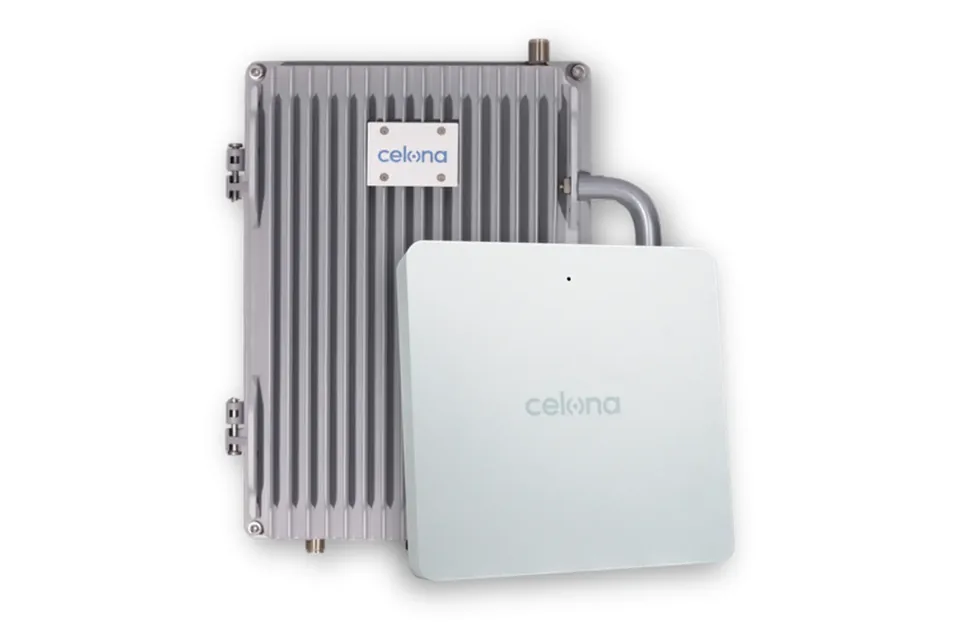
Celona Orion is a converged wireless platform that manages private 5G, Wi-Fi 7, public cellular, and satellite links as one deterministic, secure network instead of four separate systems an IT team has to stitch together.
The company built its name on private 5G for industrial sites, and Orion is the first Celona release to bring Wi-Fi 7 access points into the same subscription alongside its 5G radios. That matters for a robot fleet operator because most warehouses and factories already run a mix of both (private cellular for wide-area mobile coverage, Wi-Fi for dense fixed zones), and today those two networks are usually managed, and billed, separately.
Orion is sold on a multi-year subscription model, and Celona is rolling out its capabilities in phases rather than shipping everything at once, with the full platform reaching general availability in Q4 2026.
- Unifies private 5G, Wi-Fi 7, public cellular, and satellite under one management layer
- First Celona release to add Wi-Fi 7 access points alongside its private 5G radios
- AerConnect: an open-source wireless agent robot and device makers can embed directly
- Sold as a multi-year subscription, general availability in Q4 2026
- Built for what Celona calls the 'agentic mesh': AI systems and robots that need to act, not just report data
AerConnect: The Part That Matters for Robot Builders
The piece of Orion most relevant to robotics is AerConnect, an open-source wireless agent that a robot or device manufacturer can embed directly into a product without hiring a wireless engineer to manage it.
A robot running AerConnect can move between a private 5G cell, a Wi-Fi 7 zone, public cellular, and satellite automatically, with the platform choosing whichever link fits the task at that moment rather than the robot dropping a connection and reconnecting from scratch.
That handoff problem is not theoretical. Any AMR or mobile manipulator that roams a large facility crosses network boundaries constantly, and a dropped or slow handoff is one of the more common causes of a robot stalling mid-task or losing its position lock on a fleet-management dashboard. Operators usually blame that stall on navigation software when the actual cause is the wireless layer underneath it.
Why Wireless Reliability Is a Robotics Problem, Not Just an IT Problem
The Bot Scout tracks fleet deployments across the buying-guide side of this site, and connectivity dropouts come up as a recurring, under-discussed failure mode. A robot that stalls mid-aisle because it lost its link looks identical from the floor to a navigation bug, but the fix is completely different, and most integrators do not budget time to tell the two apart before a deployment.
Standard enterprise Wi-Fi was built for laptops and phones that tolerate a brief reconnect. A mobile robot mid-task cannot tolerate the same gap without stopping, and a private 5G network built for fixed sensors was not designed for the same seamless roaming a Wi-Fi 7 zone offers indoors. Orion's pitch is that a single managed fabric removes that gap instead of asking an integrator to hand-tune two separate networks to behave the same way.
| Approach | Handles roaming? | Who manages it | Best fit |
|---|---|---|---|
| Standard enterprise Wi-Fi | Weak (reconnect gaps at boundaries) | IT, general-purpose | Fixed stations, low-mobility devices |
| Private 5G only | Strong indoors, weak in dense pockets | Telecom/network specialist | Wide-area AMR fleets, large sites |
| Celona Orion (5G + Wi-Fi 7 + cellular + satellite) | Managed handoff across all four | Single subscription, one dashboard | Mixed-density sites with roaming robots |
What This Means for a Robot Buyer or Integrator
Orion is infrastructure a facility buys, not a robot brand. It sits underneath whatever AMRs, mobile manipulators, or automated forklifts a site already runs, so a buyer's first question should be whether their robot vendor supports AerConnect or an equivalent multi-network handoff, not whether Celona itself makes a compatible robot.
Because general availability is Q4 2026 and rollout is phased, a facility evaluating it now should ask for the specific capability timeline rather than assume the full feature set (converged 5G/Wi-Fi/cellular/satellite management) ships on day one.
For any site running more than a handful of mobile robots across a large or multi-zone floor, wireless handoff reliability is worth budgeting for as its own line item, separate from the robots themselves, the same way power and charging infrastructure already get their own planning line.
Bottom Line
Celona Orion is worth tracking for one specific reason: it targets the wireless handoff gap that causes real, under-diagnosed robot stalls on mixed-network sites, not a general enterprise-networking upgrade. Buyers running or planning a mobile-robot fleet across a large facility should ask their integrator how connectivity handoff is handled today, and revisit the question once Orion's phased rollout completes in Q4 2026.
Ask your robot integrator how wireless handoff is managed on your floor before your next AMR fleet expansion. It is a common, under-diagnosed cause of stalled robots.
FAQs
What is Celona Orion?
Celona Orion is a converged wireless platform that manages private 5G, Wi-Fi 7, public cellular, and satellite links as one deterministic network, aimed at facilities running AI systems and robots that need reliable connectivity while moving between network zones.
When is Celona Orion available?
Celona announced Orion on August 12, 2026. Capabilities roll out in phases, with general availability set for Q4 2026.
What is AerConnect?
AerConnect is Celona's open-source wireless agent that robot and device manufacturers can embed directly into their products, letting a robot move automatically between private 5G, Wi-Fi 7, cellular, and satellite links without the maker building that handoff logic itself.
Does Celona make robots?
No. Celona builds wireless network infrastructure. Orion sits underneath a facility's existing AMRs, mobile manipulators, or other mobile robots to manage their connectivity, rather than being a robot product itself.