How to Pick a Toddler Robot Toy
Toddler robot toys are pre-coding toys, cause-and-effect toys, and interactive plush toys marketed for children roughly ages 1 through 4. The buying decision is not about which robot is smartest — it is about which robot matches the child's current stage. The American Academy of Pediatrics notes that the most useful early-childhood toys are ones that reward the child's own actions and invite back-and-forth play, not screens or passive entertainment.
The Bot Scout stage-fit test: check the manufacturer's stated minimum age, check whether the robot rewards a physical action (a button, a link-together segment, a tap on the head), and check whether the parent can turn the sound down. A robot toy that fails any of those three tests will end up in a closet before the child grows into it.
Big-brand toddler robots are safer bets than no-name imports because the brands sit inside the CPSC toy-safety framework and are tested to ASTM F963-23, the U.S. toy safety standard. That does not make every toy right for every child, but it removes the worst category of risks.
- Match the toy to the child's stated minimum age, not the child's ability.
- Prefer robots that reward a physical action over ones that only play sounds.
- Confirm a volume control exists before buying — toddler bedrooms are small.
- Check battery type: AA-powered toys outlast rechargeable ones for gift-giving.
- Read the current CPSC recall list for the specific SKU before purchase.
Big-Brand Toddler Robot Toys Compared
The table below compares the six most widely stocked toddler robot toys from major U.S. brands. Prices marked confirmed were listed on the manufacturer or a major retailer at the time of review; prices marked estimated are typical street prices and will vary by retailer and promotion.
Fisher-Price is part of Mattel's brand portfolio, Playskool is a Hasbro brand, VTech is sold direct through VTech Kids, and The Learning Journey publishes its own catalog at learningjourneyinternational.com.
| Robot toy | Brand | Manufacturer age | Primary skill | Price (USD) | Price status |
|---|---|---|---|---|---|
| Code-a-Pillar Twist | Fisher-Price | 3-6 years | Pre-coding sequencing | $24.99 | Confirmed at Mattel |
| Linkimals (Cool Beats Penguin / Boppin' Beaver) | Fisher-Price | 9 months+ | Cause and effect, music, connected play | $19.99-$24.99 | Confirmed at Mattel |
| 4-in-1 Learning Bot | Fisher-Price | 9 months-3 years | Shapes, colors, letters, numbers | $29.99 | Estimated retail |
| Ready Set School STEAM Robot | The Learning Journey | 3 years+ | Letters, numbers, science facts | $34.99 | Estimated retail |
| Alphie | Playskool (reissue) | 3-8 years | Letters, matching, memory cards | $39.99 | Estimated retail |
| Marble Rush STEM Starter Set | VTech | 4 years+ | Cause and effect, marble-run STEM | $29.99 | Confirmed at VTech Kids |
The Six Big-Brand Picks, One by One
Each pick below is written for a parent who wants to know what the robot actually does at the kitchen-table level, not the box copy.
For structured pre-coding progression across the same brand, see the coding robots for kids guide. For step-up options after age 4, see the education robots hub.
- Fisher-Price Code-a-Pillar Twist — segmented caterpillar where each dial sets a direction (forward, left, right, sound). The child arranges segments to send the caterpillar to a target on the floor. Cited by Fisher-Price as introducing sequencing and problem-solving; realistically it is a pre-coding toy that keeps a 3-year-old engaged for 10-15 minute stretches.
- Fisher-Price Linkimals — a family of light-up, music-playing plush-hard hybrids (Cool Beats Penguin, Boppin' Beaver, Counting Koala, others) that respond to a tap and can play in sync when placed near each other. Age 9 months and up. The connected-play feature is the differentiator: a second Linkimal joins the same song, which most cause-and-effect toys cannot do.
- Fisher-Price 4-in-1 Learning Bot — sold in some regions as the “robot Fisher-Price 4 en 1” — swappable panels for shapes, colors, letters, and numbers. Age 9 months to 3 years. A better fit for the pre-verbal end of the range than for a confident 3-year-old.
- The Learning Journey Ready Set School STEAM Robot — a talking robot with letter, number, and science-fact modes. Age 3 and up. Volume is loud out of the box; check the volume switch before wrapping.
- Playskool Alphie — Hasbro's reissued classic robot that reads insert cards for letters, matching, and memory games. Age 3-8. Slower pace than a screen-based toy, which is the point.
- VTech Marble Rush STEM Starter Set — technically a marble-run system rather than a screen robot, included here because parents shopping “VTech marbles STEM” land on it. Age 4 and up, cause-and-effect and basic engineering play.
What About the “Learning Egg Robot”?
Parents searching “learning egg robot” usually mean one of two products: The Learning Journey's Learn With Me ABC Learning Robot, or a category of egg-shaped light-up toys sold under multiple private-label brands on Amazon and Walmart. The first is a named-brand product with a published age range and safety testing; the second is a moving field of look-alikes that change SKUs frequently.
For any egg-shaped robot toy, cross-check the exact model name against the CPSC recall database before buying — private-label toy recalls are common and the brand name on the listing can change month to month.
The Bot Scout position: buy the named-brand version even if the private-label copy is cheaper. The named brand has a support line, a manual, and a compliance paper trail; the private-label copy usually has none of those.
Safety, Batteries, and What to Skip
The largest avoidable risk with toddler robot toys is button-cell battery access. Reese's Law tightened U.S. requirements on button-cell battery compartments in 2022, and any toddler toy sold today should have a screw-secured battery door. Verify that on the physical product before letting the child play with it, especially on gift toys that shipped in mixed condition.
Skip toys with unlabeled or removed age ranges, robots that require a phone app to do their basic function (a 2-year-old does not need a phone dependency), and any robot marketed as “AI” for the under-4 age band — the label is doing more work than the toy.
For a wider view of what the education-robot category looks like once the child ages out of toddler toys, see the best robots for kids roundup.
Where To Buy
The models below are the ones we point readers at, listed in the order we would consider them. We earn a commission if you buy through these links, at no extra cost to you — it never changes which robots make the list.
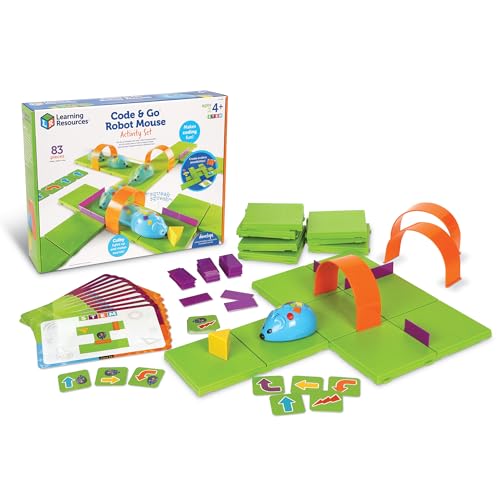
Code & Go Robot Mouse
Best first coding toyButtons on the mouse's back queue a sequence of moves through a maze you build. The cheapest honest introduction to sequencing for a four-year-old.
Check price on AmazonAffiliate link. Price and stock change constantly, so we show them only on Amazon.
- Button-sequence programming
- Maze grid and cards included
- Ages 4+
- Very inexpensive
- Maze building is half the play value
- Extremely limited program depth
- Short attention span appeal

Sphero indi
Best screenless coding robotProgrammed with coloured tiles rather than an app. The robot reads the colour and acts. The way to teach sequencing to a five-year-old without handing them a screen.
Check price on AmazonAffiliate link. Price and stock change constantly, so we show them only on Amazon.
- Colour-tile programming, no screen needed
- Ages 4-8
- Optional app for older kids
- Genuinely screenless for early years
- Immediate cause-and-effect learning
- Children outgrow it by around age 8
- Tiles get lost

Botley 2.0
Best screenless robot for ages 5+Programmed entirely with a physical remote. No tablet, no account, no app. The most classroom-proof coding robot for early primary because there is nothing to log into.
Check price on AmazonAffiliate link. Price and stock change constantly, so we show them only on Amazon.
- Remote-programmed, fully screenless
- Line following and obstacle detection
- Ages 5+
- Zero setup, no app or account
- Hard-wearing for classroom use
- Limited program length
- Outgrown by around age 9
Bottom Line
For ages 1-4, the reliable big-brand picks are Fisher-Price Linkimals and the 4-in-1 Learning Bot on the younger end, Code-a-Pillar Twist and Playskool Alphie in the middle, and The Learning Journey STEAM Robot or VTech Marble Rush at the top of the range. Match the toy to the manufacturer's stated age, confirm the volume control and battery door, and buy the named brand over the look-alike.
Check the manufacturer's minimum age and the CPSC recall list for the exact SKU before you buy.
FAQs
What is the best Fisher-Price robot toy for a 3-year-old?
Code-a-Pillar Twist is Fisher-Price's pick for age 3 and up. It rewards a physical arrangement action (setting segment dials) rather than passive screen-watching, which is what a 3-year-old's hands are ready for.
Is the Fisher-Price 4-in-1 Learning Bot the same as the “robot Fisher-Price 4 en 1”?
Yes. “Robot Fisher-Price 4 en 1” is the Spanish-language product name for the same 4-in-1 Learning Bot with swappable shape, color, letter, and number panels, ages 9 months to 3 years.
What age is The Learning Journey robot for?
The Learning Journey Ready Set School STEAM Robot is marketed for age 3 and up. Younger toddlers will find the letter and science-fact modes too advanced and will only engage with the lights and sounds.
Are learning egg robots safe for toddlers?
Named-brand egg-shaped learning robots that meet ASTM F963-23 and Reese's Law battery-compartment rules are appropriate for the age listed on the box. Private-label look-alikes should be cross-checked against the CPSC recall database before purchase.
Do toddler robot toys need Wi-Fi or an app?
None of the picks in this guide require Wi-Fi. Fisher-Price Linkimals, Code-a-Pillar Twist, Playskool Alphie, and the VTech Marble Rush all run standalone on batteries. A toddler robot that demands a phone app to work is worth skipping.
Primary Sources
Still deciding? Our top pick above, the Code & Go Robot Mouse, is the one we'd point you at.