MOVA P50 Pro Ultra vs MOVA MOBIUS 60: The Verdict
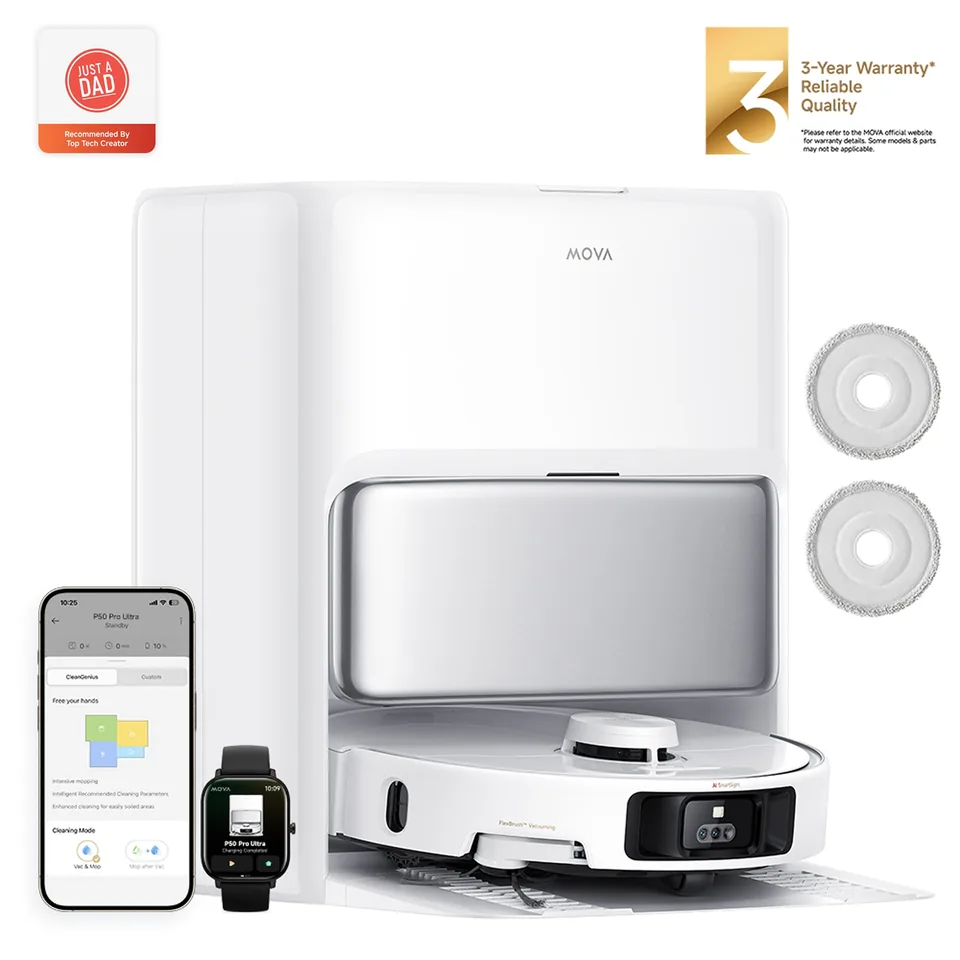
These two robots come from the same company but different product generations. The P50 Pro Ultra launched in March 2025 at $799 MSRP as MOVA's flagship at the time. The MOBIUS 60 followed roughly a year later, unveiled at CES 2026 and launched at $1,299-$1,599 MSRP (commonly sold near $999), as a step above the P/V-series in MOVA's lineup.
The most important functional difference is obstacle-crossing. The P50 Pro Ultra has no leg-lift system at all and is limited to a fixed 22mm threshold crossing on its unmodified chassis. The MOBIUS 60 adds StepMaster 2.0 retractable legs rated up to about 3.14 inches (80mm), which is the single feature that most changes what floors and thresholds each robot can actually clean.
| Use case | Better pick | Why |
|---|---|---|
| Lowest price | P50 Pro Ultra | $799 MSRP vs MOBIUS 60's $1,299-$1,599 MSRP |
| Homes with raised thresholds or door tracks | MOVA MOBIUS 60 | StepMaster 2.0 legs climb up to ~3.14 in; P50 Pro Ultra is limited to a fixed 22mm threshold |
| Deepest suction rating | MOVA MOBIUS 60 | 30,000 Pa vs the P50 Pro Ultra's 19,000 Pa |
| Per-room mop pad chemistry | MOVA MOBIUS 60 | MopSwap ships 3 dedicated pads; P50 Pro Ultra uses one dual rotary pad system for all rooms |
| Longest single-charge coverage | P50 Pro Ultra | ~1,375 sq ft measured per charge vs MOBIUS 60's ~904 sq ft |
| Auto-empty dock day-rating | P50 Pro Ultra | Rated for ~75 days between empties; MOBIUS 60 does not publish a day-rating |
| Best hair-tangle handling for the price | P50 Pro Ultra | Independent testing found 0% hair wrap on a 7-in hair test at roughly half the MOBIUS 60's price |
MOVA P50 Pro Ultra vs MOVA MOBIUS 60 Side-By-Side Comparison
Both robots scored a perfect result (0% wrap) on RTINGS' 7-inch hair anti-tangle test, so the P50 Pro Ultra matches the newer MOBIUS 60 on that specific measure despite its lower price and older platform.
MOVA's own site and independent teardown testing report different numbers for the MOBIUS 60's water tank capacity (5.5L/4.0L on the official page versus 400ml/200ml in review testing), which likely reflects two different components — a main reservoir versus an onboard robot tank — rather than a direct conflict. Treat that spec as unconfirmed pending direct verification.
| Criterion | P50 Pro Ultra | MOVA MOBIUS 60 |
|---|---|---|
| MSRP | $799 | $1,299-$1,599 (commonly sold near $999) |
| Suction (manufacturer-rated) | 19,000 Pa | 30,000 Pa |
| Obstacle-crossing | None — fixed 22mm threshold crossing, no leg-lift system | StepMaster 2.0 retractable legs, up to ~3.14 in (80mm) |
| Mop pad system | Dual rotary pads, removable, 32 water-level settings | MopSwap, 3 interchangeable pads (ThermoHold, Plush, HyperClean) |
| Mop wash temperature | 75°C (167°F) | Up to 100°C (212°F) |
| Auto-empty dock | 3.2L disposable bag, rated ~75 days between empties | 3.2L disposable bag, day-rating not published |
| Navigation | Spinning LiDAR + 3D structured light, RGB camera, AI dirt/stain detection | FlexScope retractable dToF LiDAR |
| Battery / runtime | 5,200 mAh, 210 min quiet-mode rating; ~1,375 sq ft measured per charge | 6,400 mAh, 180 min low-power rating; ~904 sq ft measured per charge |
| Hair-tangle handling | Dual anti-tangle brushes incl. CleanChop; 0% wrap on 7-in hair test | TroboWave DuoBrush plus anti-wrap omni-wheel; 0% wrap on 7-in hair test |
| Warranty | Up to 3 years | Up to 3 years |
| Release | March 2025 (CES 2025) | CES 2026 unveil; broader launch April 2026 |
When to Skip the Upgrade and Buy the P50 Pro Ultra
Buy the P50 Pro Ultra if your home has no raised thresholds, door tracks, or steps between rooms. Its lack of a leg-lift system only matters when the robot actually has to cross something, and a single-level home with standard flush flooring may never trigger that limitation.
Buy the P50 Pro Ultra to save roughly $500 on a robot that matches the MOBIUS 60's hair-tangle performance and beats it on measured single-charge coverage. At $799 MSRP against $1,299-$1,599, the price gap is large enough that a buyer without a specific need for leg-lift crossing or the highest suction rating gets most of the practical cleaning performance for less.
Buy the P50 Pro Ultra if a longer dock day-rating matters. Its dock is rated for about 75 days between manual empties, a figure MOVA has not published for the MOBIUS 60.
When to Pay More for the MOVA MOBIUS 60
Upgrade to the MOBIUS 60 if your home has raised thresholds, door tracks, or low steps between rooms. This is the one feature the P50 Pro Ultra cannot offer at any price: StepMaster 2.0's retractable legs are the difference between a robot that gets stuck at a threshold and one that lifts over it.
Upgrade to the MOBIUS 60 for the higher 30,000 Pa suction rating and the three-pad MopSwap system. Both are real capability gains over the P50 Pro Ultra's 19,000 Pa rating and single dual-pad mop design, particularly for homes with thicker carpet or mixed flooring that benefits from different pad chemistry per room.
Upgrade to the MOBIUS 60 for the hotter mop-wash temperature. A 100°C (212°F) dock wash against the P50 Pro Ultra's 75°C (167°F) matters for anyone who has dealt with a mop pad that smells sour because the wash cycle never got hot enough to break down grime.
MOVA P50 Pro Ultra vs MOBIUS 60: Pricing and Where They Fit
This comparison is less a head-to-head than a generational upgrade decision within the same brand. The P50 Pro Ultra remains MOVA's budget-flagship option a year after launch, while the MOBIUS 60 is positioned as the step above MOVA's P- and V-series, aimed at buyers who specifically need leg-lift obstacle crossing or the highest suction MOVA currently offers.
For MOVA's full lineup naming, including how the Mobius, Z, V, P, E, and S series differ, see our MOVA robot vacuum buying guide. For a broader view of the robot vacuum category beyond MOVA, see our robot vacuum buyer guide.
A buyer choosing between the two should start with one question: does any floor in the home have a threshold, door track, or low step the robot needs to cross unassisted? If yes, the MOBIUS 60's leg-lift system justifies its price gap. If no, the P50 Pro Ultra delivers comparable hair-tangle handling and better measured coverage per charge for roughly $500 less.
Where To Buy
The models below are the ones we point readers at, listed in the order we would consider them.
Dreame X40 Ultra
Best edge and corner cleaningExtending side brush and mop pad that reach into corners and along baseboards, plus a fully automatic dock. The pick if edges are what your current robot keeps missing.
Check price on Amazon- Extending side brush and mop arm
- LiDAR navigation
- Self-empty, wash, and dry dock
- Best-in-class edge coverage
- Heavy mop pressure for kitchen floors
- More moving parts to service
- Premium price
Roborock S8 Max Ultra
Best overallThe flagship most other robot vacuums get measured against: LiDAR mapping, a dual rubber brush head that resists hair tangles, and a dock that empties the bin and washes and dries the mop on its own.
Check price on Amazon- LiDAR navigation
- Dual rubber brush head
- Self-empty, self-wash, self-dry dock
- Strongest all-round cleaning in the lineup
- Dock handles almost all maintenance
- Mature app and mapping
- Top-of-range price
- Large dock needs real floor space
Bottom Line
MOVA P50 Pro Ultra vs MOVA MOBIUS 60 is decided almost entirely by one feature: leg-lift obstacle crossing. The P50 Pro Ultra has none and costs $799; the MOBIUS 60 has StepMaster 2.0 legs, higher suction, and a three-pad mop system for $1,299-$1,599 MSRP (often sold near $999). Skip the upgrade if your home has no raised thresholds to cross. Pay for the MOBIUS 60 if it does, or if the higher suction rating and mixed-floor mop flexibility matter more than saving roughly $500.
Check whether any floor in your home has a threshold or door track before deciding if MOVA's leg-lift upgrade is worth the price gap.
FAQs
Is the MOVA MOBIUS 60 worth the upgrade over the P50 Pro Ultra?
Mainly if your home has raised thresholds, door tracks, or low steps between rooms. The MOBIUS 60's StepMaster 2.0 legs are the one feature the P50 Pro Ultra cannot offer at any price. Without that need, the P50 Pro Ultra matches the MOBIUS 60's hair-tangle performance and measures better single-charge coverage for roughly $500 less.
Can the P50 Pro Ultra cross thresholds at all?
Only up to a fixed 22mm on its unmodified chassis, with no retractable leg-lift system. The MOBIUS 60's StepMaster 2.0 legs are rated to climb roughly 3.14 inches (80mm), a meaningful jump in what floors and door tracks the robot can clear unassisted.
Which MOVA robot vacuum has better suction?
The MOBIUS 60, at a manufacturer-rated 30,000 Pa versus the P50 Pro Ultra's 19,000 Pa. Both figures are motor ratings rather than independently measured floor pickup, so treat the gap as directional rather than an exact real-world multiplier.
Do both robots handle pet hair equally well?
Yes, on the specific test available. Both the P50 Pro Ultra and the MOBIUS 60 scored a perfect 0% wrap result on RTINGS' 7-inch hair anti-tangle test, despite the roughly $500 price difference between them.
Which MOVA robot vacuum has the longer warranty?
Neither has an edge here. Both the P50 Pro Ultra and the MOBIUS 60 carry up to a 3-year warranty per MOVA's official store listings.
Primary Sources
Still deciding? Our top pick above, the Dreame X40 Ultra, is the one we'd point you at.